
Category: Music Reviews

Review: Hotel Fiction: “Daydrifter”
Athens-based duo Hotel Fiction released their latest single ‘Daydrifter’ last Friday. Like every other song in their catalog, this one was also produced by Tommy Trautwein of We Bought a Zoo Records. Best friends Jade Long and Jessica Thompson are determined to bring a fresh sound to the table with every new track they put out; “Daydrifter” is no exception.
The beginning of “Daydrifter” starts off with bird songs, which was coincidentally–or maybe intentionally?– how their last single “Think Twice” ended. The song instantly sounds like a campfire tune from the bright strum of the guitar to the smooth rhymes of each phrase. Although sonically different than their previous singles, Daydrifter returns to the psychedelic lyrics and imagery that made listeners fall in love with Jade and Jessica in the first place. In their first single, “Astronaut Kids,” Hotel Fiction wanted urgently to escape the growing pains of being 20 by becoming “an astronaut who sails the sea.” And now, two years later, things have come (almost) full. As shapeshifters in “Daydrifter,” the two pronounce that they are ‘sun sailors,’ watching the sky burn. In a similar vein, Hotel Fiction desired to go to the moon and take off into the sky in “Astronaut Kids.” Now, they are still far off in the atmosphere but in a more self-assured tone. This time they are the moon craters, watching the earth turn.
The pair (or rather the trio because I have a hunch that Tommy frequently plays an important role here) have previously shown just how much they enjoy changing their sound midway through a song, either by adding something new or by taking something away. For example, in “Think Twice,” when the first segment of the song ends, they add in a minute and half long instrumental that crescendos and then floats back down. Or like in “Ghost Train,” during the bridge, when the strings drop away momentarily and all you hear is piano chords, an echoey harmony, and Jade’s vocals with a new vocal effect. And on and on… A similar shift is seen in this song. The second half adds in dreamy slides, a little twinkle in the background, and even a whole new narrative in the lyrics. Just like previous songs, the subtle tone change here works beautifully, enough to make a listener want to keep listening (and coming back).
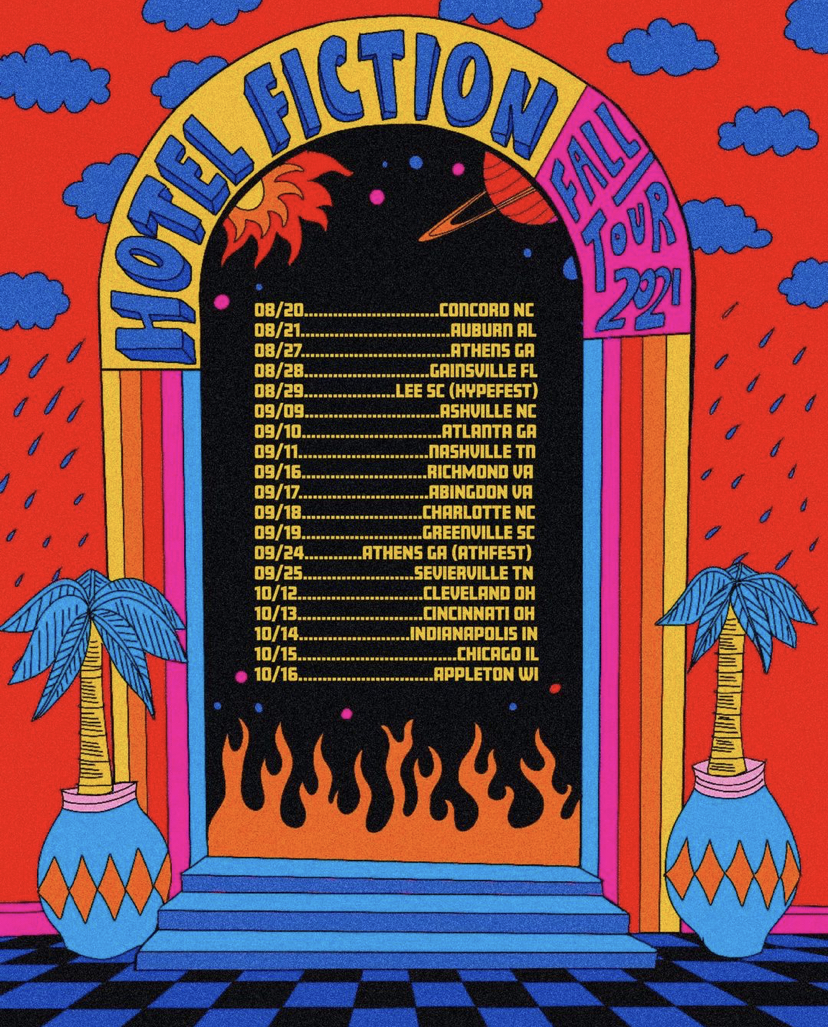
Hotel Fiction’s album comes out next month. And maybe you can catch them in your city during their Fall 2021 tour. “Daydrifter” is available to stream on all platforms.

Review: Skee Mask – ‘Pool’

Dance music has found itself in a stalemate throughout the age of pandemic. A genre whose beating heart lies on a club floor surrounded by individuals experiencing spiritual urges to move their bodies was demoralized at the snap of a finger. With physical spaces stolen away, the innate physicality of dance music became isolated inside and online.
Berlin-based producer Bryan Müller, aka Skee Mask, found himself further sharpening his production chops with a pair of EPs released at the prolonged apex of lockdown. Critics have pointed out retrospectively that these two projects are a direct response to required isolation, and I say looking back these two projects simply tease a taste of what was to come. After the well-deserved critical backing behind one of the 2010’s most fully realized electronic projects, Compro, ISS005 and ISS06 felt like a regression in scope for Müller. The stunning synthesis of ambient, dub, and break that catapulted Müller into the esteemed artist he is today were seemingly separated by an X-Acto knife. Each EP undeniably taut — breathing new life into grime and ambient production — yet lacking the humane “special sauce” that elevates Skee Mask above fellow contemporaries.
Expectations were set sky-high for Skee Mask’s full length follow up to Compro, and he meets expectations if not often exceeding them. Surfacing tracks that predate a lot of Müller’s released output while weaving current electronic ruminations into 100+ minutes of material, Pool does not amount to a mere compilation but rather feats a complete statement.
From start, opener “Nvivo” wraps listeners in a lightly tattered quilt of acid tech and ambient loops — a salutary encouragement to run outside and feel every tickling blade of grass beneath your feet. Müller follows this path towards amb-techno highlights “Rdvnedub” and “CZ3000 Dub”, with the latter track’s twinkly yet cathartic push-and-pull primed and ready to load into a CDJ. Müller’s toe-dip into footwork on “Pepper Boys” features a youthful whimsy akin to Suzi Analogue or Vegyn’s recent work. Pool leans into the sonic playground that dance music can be, further reminding listeners that only a sympathetic being could construct sounds such as these.
As Skee Mask handily swims further into the deep end, the current sucks in moments like “Breaking Method,” an unrelentingly aggressive breakbeat cut fitting in snuggly amongst the Ilian Tape roster. Another highlight, “Testo BC Mashup”, opens with a jumbled radio transmission only to dunk you head first into drum & bass rhythms followed by ambient soaked hats and pads allowing a moment for air, before the D’n’B pulls us back in. It would be remiss to not vet the contemplative “Ozone” or the subsequent exercise in self-doubt: “Rio Dub”. Each track operating miles above sea level for some necessary R&R. And this is not to say that Müller has depleted listeners’ stamina, rather each track takes the form an undulating body of water.
Skee Mask has cemented himself as an artist whose undying ambition remains his greatest strength. The “special sauce” missing from aforementioned Iss05&06 is the worldliness that Müller so effortlessly breathes into the inherently digital. For Pool, Müller looked outside for grounding: thin air mountain tops and crashing waves characterize the form these tracks heed to (easy to see why Müller pays respect to one of Germany’s ambient techno greats). Not only does Skee Mask deftly wield the line between analog and digital, but also the past and future. Each track on Pool is familiar via Müller’s comprehensive music knowledge and dedication to creating something wholly his own.

Review: Lucy Dacus: ‘Home Video’
Home Video is a stunning collection of delicate coming-of-age moments packed with emotional vulnerability and scenic poetry. Lucy Dacus, 26, brings to life nostalgic tales of her Christian youth camp days, friends dating subpar boys, awkward firsts and confused teens replacing pop culture references for a personality. Presumably, the effectiveness comes from the way she read through her teenage diaries on the road towards the finished product. In reflecting on the past, she has masterfully (and perhaps unintentionally) created a looking glass for listeners to project their own teenage emotions and formative experiences onto.
The charm of these songs comes from Lucy’s conversational tone, wit and self-awareness. “First Time” finds Lucy confessing, “I am just the fool you took me for.” She professes via Apple Music that the song explores discovering “your body and your emotional capacity” for the first time and the fear that you’ll never feel that way again. Then she admits, “I haven’t–but I have felt other wonderful things.” “Partner in Crime” reminisces on her early relationship with an older someone; Dacus makes her first experimental step into autotune, describing her desire to pretend and act older. In a casual voice, she sings, “You drop a hint that you got a girlfriend / I tried my best not to take it” over distorted guitars.
Home Video is a glimpse at art that is so personal, intimate and vivid that the stories it tells become approachable, cozy and universal. As you zoom into the picture, you find that there’s details that you can latch onto and make yours. Its diverse palette and keen observations enables one to shapeshift. Sometimes, you feel like the songs are about you, and sometimes, you feel like you’re Lucy and you’re seeing your friends through her interpretation. In “Please Stay,” the first verse describes the unkempt house of an individual struggling to find a reason to stay alive. The outro, assisted by her boygenius bandmates, sings pleadingly and desperately for the subject of the song to do anything but leave. In another song (“Christine”), Lucy describes the way her friend justifies staying with a boy who doesn’t treat her right. With unadulterated honesty, Lucy confesses that she would risk losing her friends respect to stop them getting married if it came down to it. Throughout each song, both the observer and the subject are continuously done justice in this way.
In the end, I can’t help but wonder how it must feel for the people in Lucy’s life to hear the songs that tell their stories, to hear their worlds come alive in a picture book painted by someone else entirely. In some ways, as a listener, it feels invasive to realize that these songs implicate real people. The consequences of putting these songs out into the world are genuine and to some degree, change how one consumes them. In a recent interview with Rolling Stone Music Now, Lucy describes the anxiety of anticipating to hear from the subjects of her songs. She confesses that the subject of “Brando” contacted her after the song was released and expressed hurt. On the other hand, “Thumbs” and “Christine” are two songs that she asked for permission to record from the people it’s about. Songs like “Triple Dog Dare,” “Cartwheel,” and “VBS” could still be conversations waiting to happen between Lucy and the people she is singing to, which is the price paid for hyper-specificity. She acknowledges that some of these conversations she welcomes and others she would dread but leaves you guessing as to which category they fall under.
When the world shut down in March 2020, we were forced to spend time thinking about the past because there was literally nothing else to do. There was nothing happening in the now and nothing to look towards or anticipate. Although recorded before quarantine, Home Video somehow captures this feeling, at least for me. This album is unique in that it reflects on pivotal moments in one’s life from the end of the road, yet the distance isn’t so far that the details have become hazy, and the aftereffects have been lost during interpretation.
Home Video is available for listening on all streaming platforms.
Review: CLOUDLAND: ‘Where We Meet’
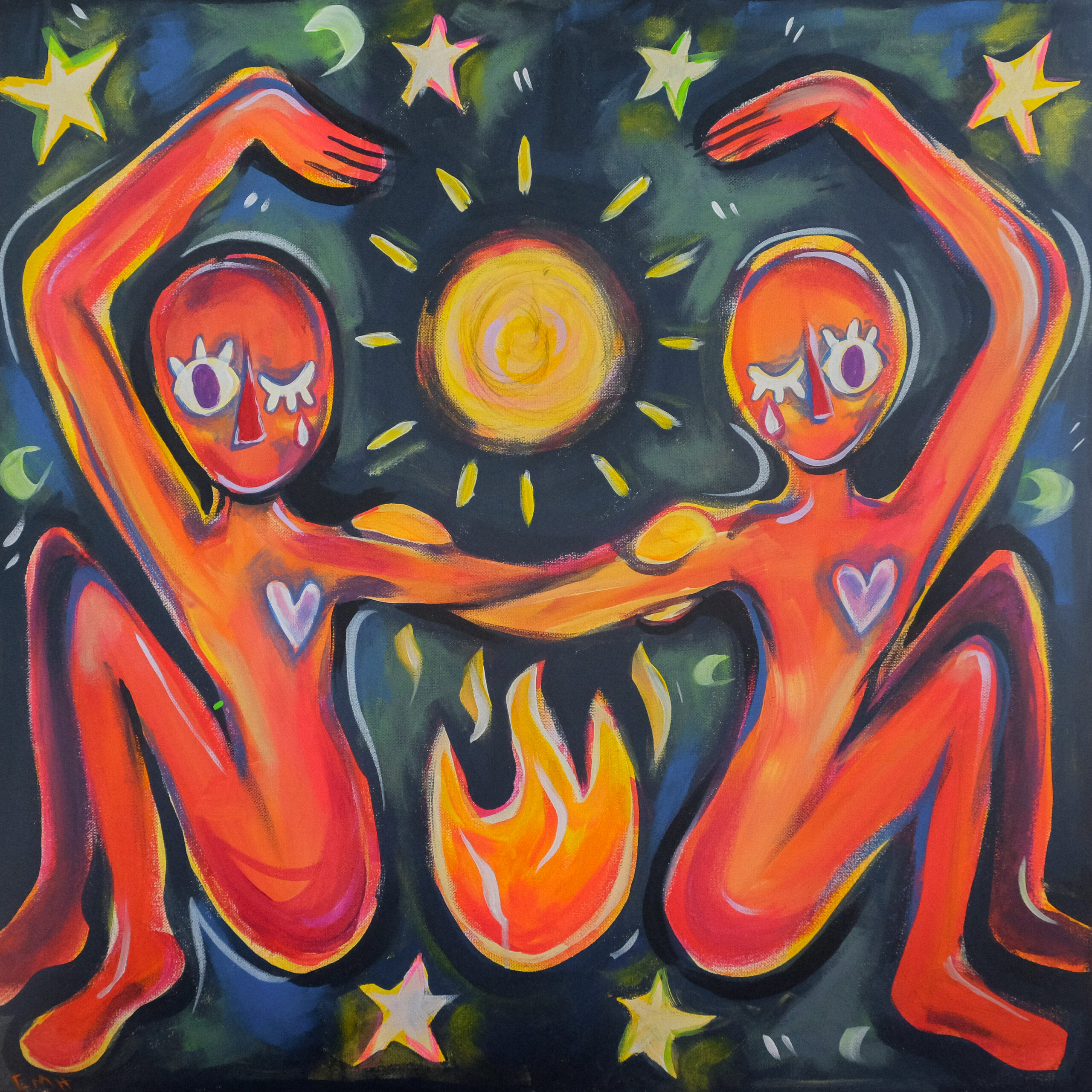
As the clock strikes midnight, CLOUDLAND, based out of Athens, Georgia, celebrates the release their debut album, Where We Meet. The four-piece rock group is made up of members: vocalist Zach King, Karmen Smith on drums, guitarist Aidan Hill and Hogan Heim on bass.

The ten-track album was written over the last year and a half, handing us the means to cope with the solitude we have all felt recently but also the relationships we have curated and reinforced, stronger than ever before.
“Sunday Afternoon” eases us into this significant milestone of CLOUDLAND’s —acoustic guitars extend their reach to greet us, vocal harmonies enticing us to stay. Truly depicting of a Sunday afternoon with a hint of what’s to come in the week. And just like a Monday, “Overthinking” wakes us up from our breezy, Sunday haze. “Thinking straight is something I can’t do… while my mind’s on you.” This track stuck out the most to me with a chorus that you just have to loudly sing along to in the car, and the sweet innocence of being absolutely enthralled by another is something that should be cherished. This came out to be one of my favorite tracks from the album; it offered enough in the instrumentals — the punchy guitars, the drums backing up the energy of the song, and the catchy vocals. Personally and a little surprisingly, I found the titular track, “Where We Meet”, to be one of the lesser hits off the freshman album. It reminded me a bit too much of my own youth group days, but that’s trauma to unpack another time.
Next up is the recently released single, “St. Elmo” — the band writes, “It’s about having someone by your side that can take all the confusion of self doubt away by just holding your hand.” Along with track two, “Overthinking,” this is an automatic add to any roadtrip playlist, from Chattanooga to St. Elmo to North Shore. “Lights” is next, a track that gives me hints of nostalgia for the nights I never lived, the memories I haven’t yet created, within in the coming-of-age film I never will star in. Midway, the album is struck by what seems like the tail end of an alien invasion dream, the piano keys of “Sunday Evening” waking you up from your feverish illusion. Continuing on, a track that hit a little too close to home is “Walking Away.” King asks, “Did a dream just die?” A question we might never get the answer if we quit pursuing. But, as a response, “Coming Back,” the moody guitars and instrumentals echo the lyrics, the two deep in conversation. Taking a different approach, “Restless” shows a much more emotionally vulnerable and softer side of the band featuring higher pitched vocals, an entrancing guitar progression, and soft drumming. “I am restless inside of myself. I’m always trying to be something else.” “Perfect Timing” brings it home with bursts of energy we almost forgot existed, closing the album out with a lulling trickle of shoegazy guitar and whispers of harmonies.
Where We Meet is available for listen on all streaming platforms, and Georgia fans, keep an eye out for CLOUDLAND’s show dates in Atlanta and Athens.
Recommended for fans of Moon Taxi, Bad Suns, and Hippo Campus.
Tracklist:
- Sunday Morning
- Overthinking
- Where We Meet
- St. Elmo
- Lights
- Sunday Evening
- Walking Away
- Coming Back
- Restless
- Perfect Timing

REVIEW: Kareem Ali – ‘Getting Through’

Upon doing research for this review, I noticed that Phoenix-based producer Kareem Ali’s Instagram bio reads “I create music for everything in the universe”. Marry this ethos with Ali’s one-of-a-kind Boiler Room mix, set in the sunset-soaked desert outskirts of Phoenix, and this mission statement tells listeners everything we need to know.
Throughout the past year, Ali has been garnering acclaim from artists and publications across music, with Resident Advisor claiming that Ali “might be the house artist on the pandemic era”. With 100+ tracks under his belt in the past year, this take couldn’t be overstated. After several years of working in the shadows, Ali has collected co-signs from some of the most current voices in the electronic music landscape, landing himself a spot on AceMo and MoMa Ready’s “HOA012” compilation along last year with the likes of Loraine James and the aforementioned NYC-based duo, AceMoMa. What stumps my brain about RA’s claim is the innate connection Ali’s music to the earth itself and the world that surrounds us. How can 2020, a time characterized by the time we spent indoors, be reflected on through somebody who’s vision lies outside?
Ali’s most recent EP, Getting Through, provides us with insight regarding how this could be possible. The project opens with “Como Me Siento Por Ti (Instrumental Version)”: a track primed to join Luomo on any Crying in the Club playlist. Ali starts the track off with repeating synth chords, held down by piano notes that lead these arpeggios, swelling until percussion kicks down the door. A faint vocal loop musters out “I feel so alone” as the track’s calculated pace chugs along. The vocal loop feels confessional; as if the person’s best friend pulled them off the dancefloor to ask, “What’s wrong?”
The next track, “Pushing Through”, puts Ali’s versatility front and center. Ali stews in feelings of isolation; turning 90 degrees away from house towards trip-hop. Muted vocals and drums reminiscent of Geoff Barrow’s work are not intent on pulling us out of the emotional slump quite yet. And before we know it, Illangelo-like percussions patterns kick off “Dreams of You”, building towards the spiritual confrontation of “Feelings Never Go”. Ali’s hypnagogic vocals repeat the phrase “Outside, inside flawed in love/The feelings always stay, they’ll never, ever go” as arpeggios sugarcoat kicks that fight against the rhythm. The result is remarkable as Ali keeps listeners in their bag while constantly bobbing heads.
Getting Through’s closer, “Euphoria”, proves to be the most uplifting track on the project. Ali channels a techier side of house while keeping the instrumentation distinctly fresh. Synths are the punchiest on the project and the speedy BPM treats those ready to be back in the club. Past the upbeat feeling of “Euphoria”, I find the answer to the question posed earlier. Understanding the connection between others, ourselves, and the earth we walk on lies at the heart of house music; Ali just digests this connection through a spiritual identity. After a year of the inside/outside dichotomy remaining forefront of many people’s minds it becomes obvious why such praise has been thrown Ali’s way.

REVIEW: DoFlame’s “Bat House”

18-year-old DoFlame made his debut just a few weeks ago with single “Bat House.” If I could describe this track in a just one sentence, I’d say, “90s nu trash is back, baby.” But, we have the privilege of free speech, so let’s continue.
I can’t say I expected a 2003 baby to make his debut with such a clash with clangs of 90s alt nostalgia, electronic switches on high and etchings of modern rap weaved throughout. “Bat House” perfectly encompasses teenage rage in a way that is so digestible; loud, angry, demanding of your attention, and they want it now. With an equally chaotic music video, this single is out to break some necks.
Upon some primary research, DoFlame, or Mateo Naranjo, and peers are working on collective OFFLEASH Worldwide, site featuring the “Bat House” video with flaming handheld camcorders surrounding the now old-school video player. Still so new, this group’s progression is something to keep an eye on.
DoFlame’s “Bat House” is available to listen on Youtube and Spotify.

REVIEW: Cities Aviv – ‘The Crashing Sound of How It Goes’
I was stuck in a place/I couldn’t get up/what happens next?
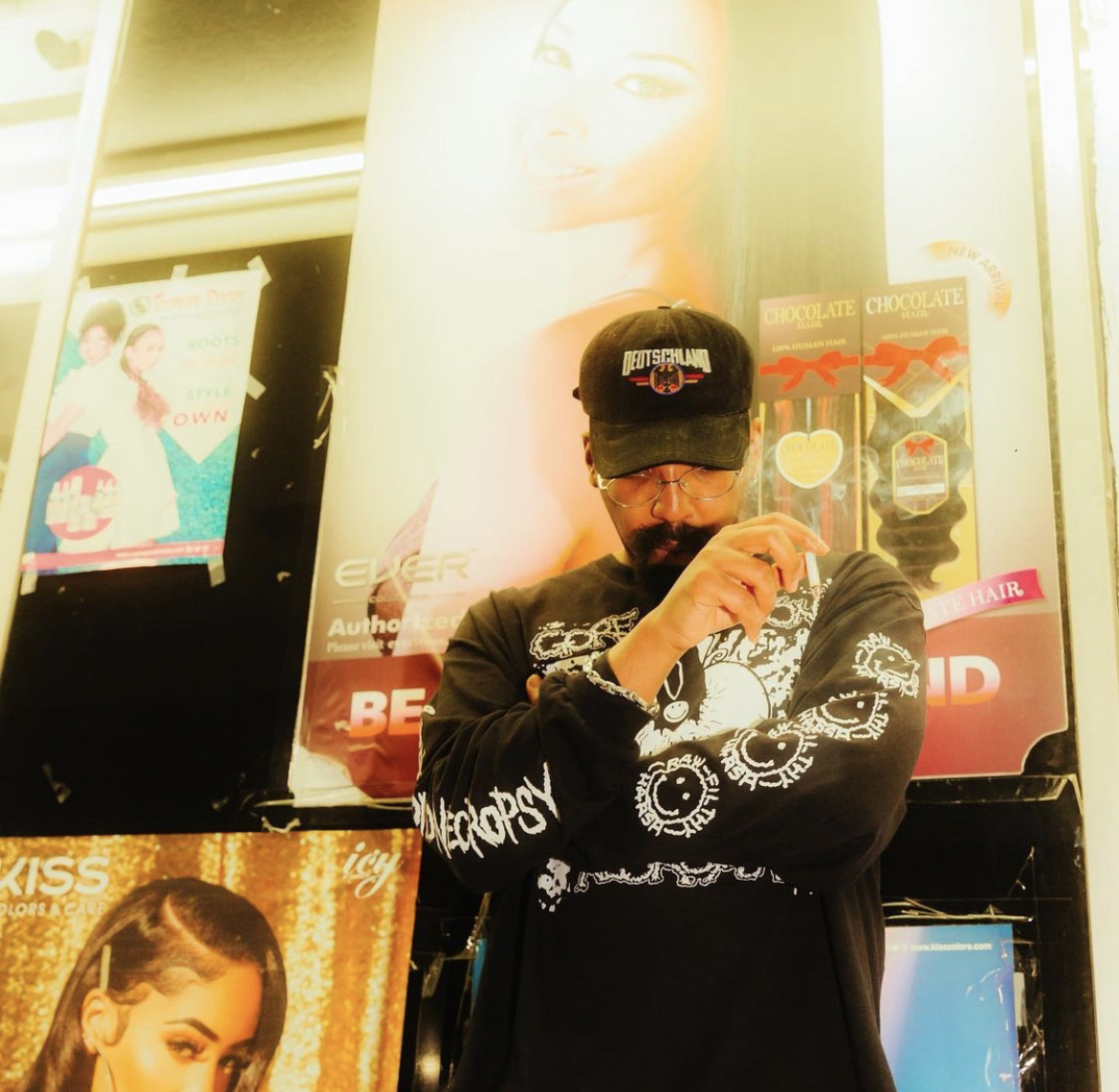
How does one begin to grieve growth from one chapter of life to another? Loved ones lost, a regressive sociopolitical landscape, and the impending fears of aging all come crashing down on one to the point of mortal acceptance. Memphis-based writer/rapper/producer Gavin Mays, professionally known as Cities Aviv, opens The Crashing Sound of How It Goes with an answer to this question: “Let’s make the day intentional… Let’s make the day worth something”. Yet seldom do we find an answer to these plaguing thoughts at any point of our lives, let alone at the beginning. Regardless, this mantra of “Let’s make the day intentional” is a starting point.
For the last decade, Mays has been quietly evolving his voice, as fitting ways to express himself become apparent. Listeners are quick to draw comparisons between his output and whatever movement in rap is dictating the current zeitgeist (see any of Pitchfork’s reviews of Mays work or the RateYourMusic comment box for The Crashing Sound…) but fail to acknowledge what strength lies in the freedom Mays wields over creativity. But in part you can’t blame these critics’ shortsightedness; Mays’ sound is impossible to pin down. He constantly switches up his sound from project to project but keeps hip-hop, electronic production, and collage-like arrangement as grounding forces that allow his voice in rap to remain completely singular. The Crashing Sound… is no exception with Mays allowing soul, jazz, and pop loops to articulate where his head is at.
Mays finds himself asking the world to help him bear personal weight on his shoulders; allowing production to build a foundation for questions he struggles to answer. “Near You” features a sample that cries out “I just want to be near you” while Mays asks, “what’s the status of these barriers between you and me?” Fans of ambient and loop music are invited to join with “Face Pressed Against Glass”, where Mays dives headfirst into electronic soundscapes that radiate piercing hope through the other side of his apartment window. The effect is similar to the brazen confidence of “Imma Stay Here”, with Mays unapologetically shouting self-love proclamations from the rooftop. Now don’t get it twisted, these two tracks are diametrically opposed in energy, but reinforce the notion that Mays is the protagonist of this discombobulated narrative. Both tracks warrant smiles from the listener, with varying levels of teeth showing. The smiles are few and far between throughout the track list but keep listeners from tiring over the Mays’ immobility.
If a single word had to sum up what Mays is looking for throughout The Crashing Sound… it would have to be clarity. Recurring themes of peering through holes (keys, crevices, levees breaking) litter tracks as the quest for answers unfolds. Why don’t we talk anymore? What went wrong? Do you realize what I gave up for this? Why is the worth of my life deemed less? Why was he the one to pass? These questions bounce around Mays’ head for the duration of the project until the levee breaks with the realization on “Series of Goodbyes”. Mays lets out a drunken declaration that he will “sculpt a better way to break the mold and operate” while thanking everyone that stayed with him through the process. He finds the crushing volume that uncertainty rings at in our ears is no longer as loud as it once was.
The Crashing Sound of How It Goes is now streaming on Bandcamp and Spotify

REVIEW: Bobby Kid – “Blue/Dissonance”
Who am I, and who are you? Growth. Fear. Changes. The nostalgia of it all. Who are we if I am no longer who I used to be? We desperately cling on to our past in hopes of using it as a band-aid, a short term justification, to heal what we face now. And most of the time, that just isn’t enough.
Hailing out of sleepy Jacksonville, Florida, Bobby Kid has finally come back to wake up out of our 2020 depression slumber. Bobby Kid officially grouped in 2017, and in 2018, they dropped their debut album, Peach, perfectly encapsulating our feelings of childhood, the longing to reconnect with your roots after you’ve gone too far, and first heartbreak. “Blue/Dissonance,” a two-track EP, was released in late March 2021, now available on streaming platforms and for purchase on Bandcamp.
I don’t want to be funny.
I don’t want to be pretty.
I don’t want to be cool.
I just want to be you.
With a whisper, “Blue” subtly demands your attention. “Eat my words, see how they taste,” singer-songwriter Anna Lester pleads through her lyrics. She questions the perception of ourselves made by others, the impact that their supposed-innocuous presence has on our self worth. We can ask ourselves a thousand times on how to become the person that everyone expects us to be, and to stay, and never know the answer. And that’s okay. With a crash, the whisper breaks into a harmonious strew of instruments. I’m a lot… I’m a lot. To close, Lester backs away from her contemplating lyrics, accompanied with evocative instrumentals, to let out distressed wails, bringing the song to a close. The final calm after the storm.
But my insides are turning out towards the sun,
And I feel like I must be the only one.
And I’m crying, lord, I’m crying.
The next song on the long awaited EP is titled, “Dissonance.” Dissonance is defined as the clash of two unharmonious elements, often coupled with your mental state as “cognitive dissonance,” where your actions and your thoughts fail to align. This track immortalizes the feeling of floating through daily life yet failing to recognize the improvements we make in our lives. Recognizing we are worthy is the biggest accomplishment, and we consistently strive hard to achieve it. There’s a lot to love about this track: the soft harmonious vocals, the twinkly, sway-worthy drum work, and the rhythmic guitars. This is definitely one of those tracks where it makes you float around the solo cup-ridden kitchen one moment but have you crying in the house show’s bathroom the next.
Fans of Julien Baker, Phoebe Bridgers and Lunar Vacation can find comfort in Bobby Kid’s words and melodies as we navigate the confusing phenomena understanding who we truly are, imposter syndrome aside. Breaking your heart and mending it all at once is something Bobby Kid has always done right, and we are excited to see what comes of this quick impression of tasty tunes.

Courting: ‘Grand National’
If there’s anyone who hasn’t lost complete touch over the ever-fleeting artistry of social commentary rock, it would undoubtedly have to be the Brits. Championing the genre as what might be a post-post-punk reaction to the spawn of angsty British lyricism, Courting have recently released a 4-track debut EP that delivers a wonderfully refined twist to contemporary British rock in a way we haven’t seen for quite a while. In recent years, fast-paced, talk-singing punk bands like IDLES, Shame, Black Midi, and Black Country, New Road, have come to dominate the British indie and underground rock scene, paving the way for a new-age niche punk genre, lyrically packed with political criticisms and socially charged objections to the systems we’ve found ourselves uncomfortably embedded into. Courting’s mission with their music more than adequately follows suit from this distinct style, however within an arguably more derisive– cheeky, even–lyrical framework.
Rhythmically sound and anticipatory in its build of angst, Grand National covers an impressive scope of socially perceptive topics. At the forefront of the band’s social revelations, however, is blunt in the name: the Grand National is a prominent horse racing event that takes place annually in Liverpool, England (their city of origin). This obvious expression of contempt for events like the British Grand National perfectly matches the overriding theme of the EP’s lyrical sentiment. Singer Sean Murphy O’Neill’s abrasive chants resonate with me as a collective frustration that many young revolutionaries–as well as casual social observers–increasingly share: something about feeling ridiculously unattuned to some of the similarly abuse-ridden practices as horse-racing. Themes that appear throughout Grand National’s musical dialogue are society’s persistent devotion to practices of capitalism, mundane yet obnoxious displays of wealth, along with the generally exploitative nature of pop culture, music, and art. Sarcasm, humour, and wit encompass the EP’s thematic makeup, accompanied by deliveries of very valid criticisms and catchy, gritty guitar riffs. The EP begins with an outright objection of British national norms and values, found abundantly in Grand National, weeds through scattered ideas surrounding casual elitism present in various British social arenas, and resolves on justified jabs at the confusing yet enduring influences of Kanye West and Ed Sheeran. In fact, that’s kind of all that “PopShop!” is about. The song delves into the dire state of popular music and musicians: an unceasing cycle of often problematic pop icons dominating charts, and producing the same disposable yet generically profitable sounds. Furthermore, “Popshop!” chants on about other long-standing issues of the music industry, such as the age-old theme of selling out to corporate ownership and labels’ soul-sucking tactics of artist exploitation.
Between their contemplations over lawn culture being kind of odd and unnecessary, and their more critical takes on social media’s tight grip over our priorities and perception of reality–Courting have devised an astonishingly catchy, and tastefully punk, first EP. With only a few songs out before Grand National, it serves as an exciting introduction to the musical potential of Courting, a group of four nonconformist Brits clearly committed to their authenticity, and more importantly, to never selling out.
Check out the EP on all major streaming platforms and Bandcamp, link below.
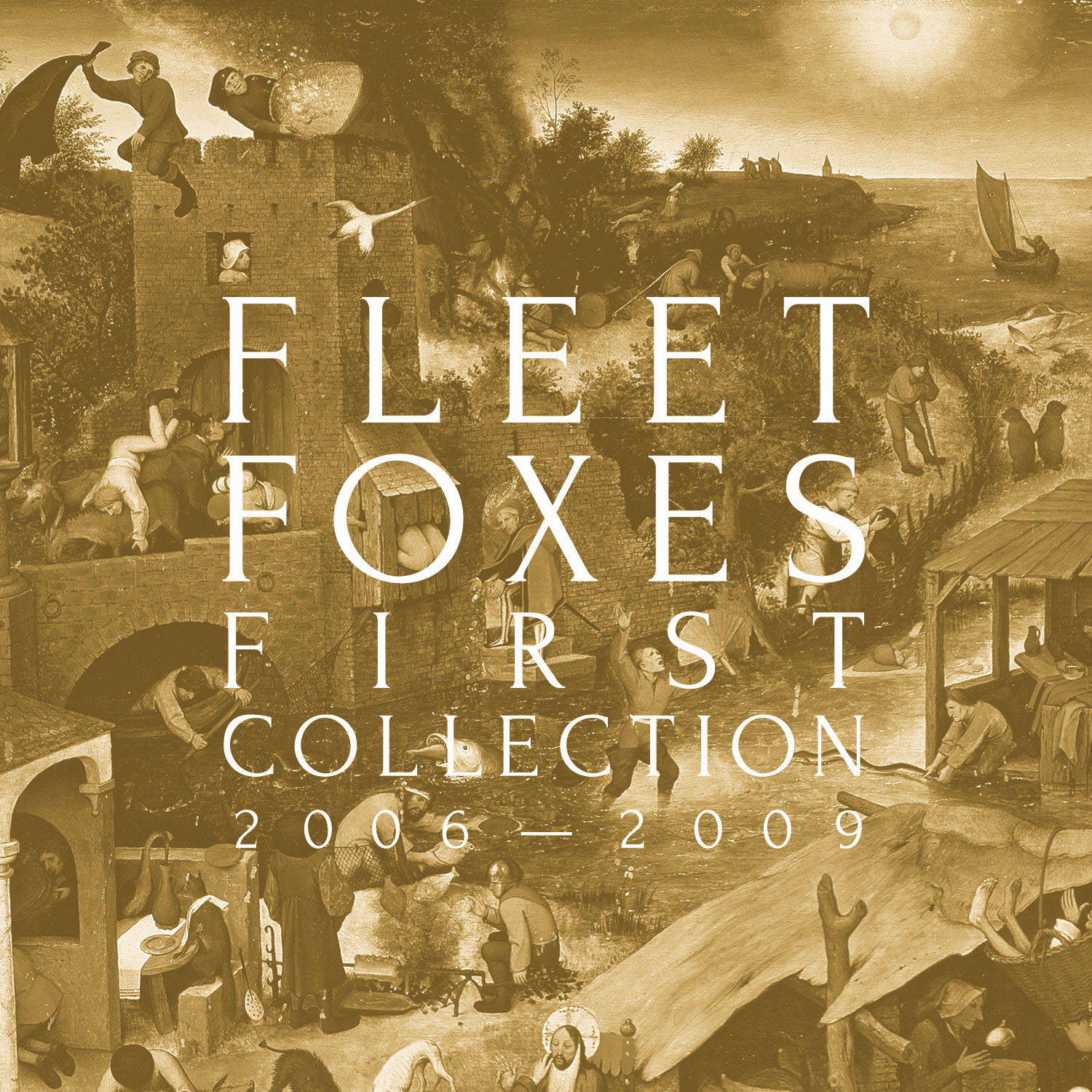
Fleet Foxes – ‘First Collection 2006-2009’

Nostalgia is a powerful feeling, providing respite from the present day. Music continues to find ways to replicate former fond feelings: a day at the beach, a sunset with friends after a long hike, or a cozy evening in the mountains. If there is a specific minutiae-filled time and place that one longs for, it’s likely able to be reached through music made in the past 10 years.
Fleet Foxes’ First Collection 2006-2009 chronicles a band that grasped that sense of nostalgic aesthetic and interweaved new sounds to push a solid vision forward. Chronologically, every release feels like hitting the bullseye of a high and clearly marked target, every record higher than the last. Nothing ever feels like a rehashing of yesteryear’s folk, but rather a creation of new space comprised of traditional balladry, sun-filled west coast pop, and country crooning.
The collection is comprised of four releases: their self titled debut LP (2008), the critcally-acclaimed Sun Giant EP (2006), the self-released The Fleet Foxes EP (2006), and an unreleased B-Sides and Rarities, all of which are seeing vinyl pressing. Accompanying the albums is a 32-page booklet showcasing artwork, photos, tour posters and the like from the time period. Combined, they are a document of a group spanning the sounds of time with clear direction.
The Fleet Foxes EP is a golden-toned bill of AM country influenced tracks that billow and unfurl like the opening of a brass horn. The reliance on guitar chord work and choral breakdowns is as fast paced as the band has ever been, but it still takes its time. “In the Hot Hot Rays” flirts with early R&B in both vocals and guitar work. To those who haven’t heard this release, this is Robin Pecknold with an outward swagger and strut. The closer, “Icicle Tusk,” is the biggest indicator of where the band would head from this EP: a reserved confidence in filling a room with less.
The band made it clear that the Sun Giant EP was simply something to be sold at the merch table of the shows and to not see it as a true indicator of what the band wanted to achieve. If we take them at their word on that, we can instead view the release as a marker on the map up a high mountain. Suddenly, this grasp on nostalgic tones was being pushed into vast soundscapes that seemed to sprawl over terrain. In particular, “English House,” peppered with vocal harmonies to the instrumentation, rolls like a fast morning fog and settles like dew on the ground. Something so big, yet delicate when hitting the ears.
The self-titled LP met high hopes, showcasing the band’s versatility and awareness in executing several genres well. The songs seem to take up even more space than anything they had previously released, but with such a focused assurance. Tracks such as “Ragged Wood” and “He Doesn’t Know Why” seemed to melodically span generations. Perhaps their most famous track to date, “White Winter Hymnal,” plays with traditional folk song language and circular storytelling, creating a short, timeless masterpiece.
The B-Sides and Rarities album, when listened to after the rest, can be seen as a deconstruction of what built such solid focus. Pecknold’s take on the traditional ballad, “Silver Dagger” whisfully slides in, both assured and filling. The basement demos demonstrate that their song ideas were by long-term design, whether they resemble their recorded versions (“English House”) or bare little semblance at all (“He Doesn’t Know Why”). The photos in the accompanying booklet are nice, but the rarities collection is much more of a time capsule into this band’s history.
In the years following the time span that this collection records, their focus branched out even further, digging deeper into the roots of taking traditional songwriting sounds and pushing them into modern soundscapes, both in grandeur (2011’s Helplessness Blues) and mystery (2017’s Crack-Up), but these initial releases were a swell of prowess and thoughtful tellings of songs that spanned time. Fleet Foxes write songs that you can come back to, and no matter how the world changes around you, there’s always space to take; sometimes, that space can be as big as the horizon.
9.3/10.0