
Tag: review
Warning: Attempt to read property "post_id" on null in /dom375187/wp-content/plugins/enhanced-category-pages/classes/ecp/Enhanced_Category.php on line 143
Warning: Undefined array key 0 in /dom375187/wp-content/plugins/enhanced-category-pages/classes/ecp/Enhanced_Category.php on line 232
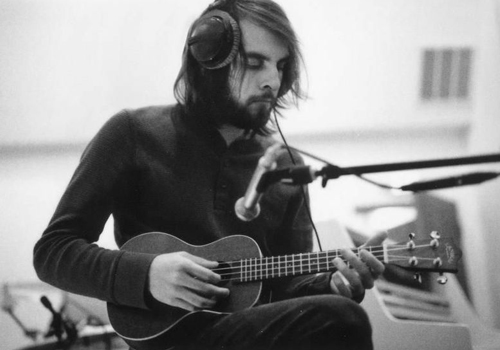
REVIEW: Valaska’s Natural Habitat
With the warm, lazy summer months ahead, what could be better than a pensive indie album with fantastic acoustic instrumentals? Enter Valaska’s new album, Natural Habitat. The brain-child of Chicago native Dave Valdez, this record will uplift you with its often cheery acoustic guitar, then force you into a state of reflection with its unabashedly meaningful lyrics.
Produced by Copeland frontman Aaron Marsh, the album is clearly the result of much introspection and a complete turnaround in musical style – Natural Habitat is far more raw and thought-provoking than Valdez’s 2010 EP. Also notable is how influenced Valdez obviously is by acts as diverse as Elliott Smith, Bright Eyes, Iron & Wine, and Of Monsters and Men. This mash-up, whether Valdez is conscious of it or not, gives the listener a positively chilling indie experience.
The Elliott influence is apparent – and incredibly poignant – from the first track, “On the Surface”. Vocal layering and an emotional acoustic guitar pave the way for the song’s insightful take on man’s tendency to only scratch the surface of things. The record ironically picks up a bit with “Spanish Needles”, a tune entirely about the inevitability of death. Another favorite is “Golden Age”, a track that reveals Valdez’s experience touring with pop rock bands for a large chunk of his life – it’s undeniably catchy, even sweet, whisking us away to a different time and place.
By “Wildfire”, we’re hooked. The song presents a situation that everyone is familiar with: the promising nature of a fresh relationship, but also the care involved in seeing someone new. The title track, toward the end of the album, provides a comprehensive summary of Natural Habitat and Valdez’s new musical direction. It’s all about being alone, thinking everything through, and the array of emotions that coincide with that experience. Raw and whimsical, the track helps to wrap up the album in a beautiful little bow.
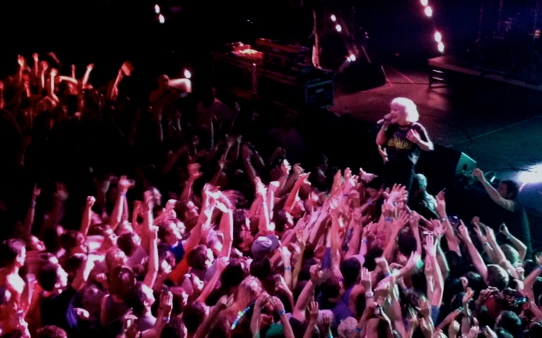
SHOW REVIEW: Crystal Castles at the Tabernacle
A threesome of musicians swarmed the Tabernacle stage, awash in black, taking their places before a massive, eerie depiction of a cloaked figure embracing a naked human form. The waifish, platinum blonde front woman, Alice Glass, took a drag from her cigarette as the heavy beats reverberated around the room.
Crystal Castles provided an incredibly contradictory show in the best way on April 17. Though Glass and crew entered the stage to a near riot – the audience had waited over an hour for Crystal Castles to come on – the stall proved to be entirely worth it. Opening with “Plague”, the first track off their new album, (III), it was quickly clear that this set would be all about digital, electric glamour with a wash of old-school punk ideals.
Soon enough, the trio – consisting of founding members Glass and producer Ethan Kath, and touring drummer Christopher Chartrand – dove into tunes from their previous album, including “Baptism” and “Suffocation”. This is when things became truly rock ‘n roll. Between Kath’s impressive electronic instrumentals and Chartrand’s mind-blowing drum solos, Glass struggled to pull away from a security guard and crowd surf several times, and even began taking massive swigs of whiskey and spitting it over audience members.
We were most thrilled when we heard the first few beats of some of our old Crystal Castles favorites: “Crimewave”, “Alice Practice”, and a portion of “Vanished”, to name a few. By this point, Glass knew she held the crowd in the palm of her hand. She stood before thousands of energized fans, slugging from that same bottle of whiskey and twirling the microphone in her hand, as if teasing us to beg for more.
And “more” is what we got: among the trio’s encore songs was “Not in Love”, their undeniably catchy cover featuring Robert Smith. While we danced nonstop for the last minutes of the show, we couldn’t help but think how in love we were with Crystal Castles’ live performance.

REVIEW: Deadstring Brothers’ Cannery Row
Close your eyes and envision this: members from Ryan Adams’ The Cardinals, Willie Nelson’s band, Whitey Morgan and the 78s, and Poco get together to make an album. You’re probably drooling by now, right? Now, open your eyes, grab your keys, and go out and buy Deadstring Brothers’ newest album, Cannery Row. You’re welcome.
From the very first track, “Like A California Wildfire”, frontman Kurt Marschke’s voice paired with some very alt-country instrumentals draw undeniable comparisons to the Rolling Stones circa Exile On Main Street. Yeah, heavy compliment, but this is one group that’s earned it – by the time you get to the album’s title track, you’re hooked. “Cannery Row” is a slow, mournful tune that reveals Ryan Adams backbone whilst keeping a very “Wild Horses”, Rolling Stones sound. The female vocals really make this track pop, though – they’re a much-needed calm before the fun, danceable, country storm that is “Lucille’s Honky Tonk”. Trust us, you’ll suddenly feel like you’re in a saloon in the old west as you move and step to “I can hear her when she sings, and the beauty that it brings. Yeah, we’re swinging down at Lucille’s Honky Tonk.”
As you approach the end of Cannery Row, you’ll be struck by how White Stripes-esque “Talkin’ To A Man In Montana” sounds instrumentally. It’s the perfect hit of country rock as the female vocals return once again to add dimension to the song. The record ends with “Song For Bobbie Jo”, a measured yet complex ballad in which Marschke croons, “I’m comin’ home for good, I’m comin’ down like no one ever should,” before escalating to nearly yelling, “You know, there’s times when I might need a friend.”
Cannery Row shares its title with a 1945 John Steinbeck novel set in California. Why is this even relevant? Well, yes, the album and the novel are both reminiscent of a very country-influenced era and region. More notable, though, is that, like Steinbeck’s novel, this Deadstring Brothers masterpiece will be put down in the books as irrefutably timeless.

Review: Luke Winslow-King’s ‘The Coming Tide’

Thank God for Luke Winslow-King. In a musical era in which simple beats and perverse lyrics reign supreme, and enjoying quality music puts you in the minority, Winslow-King brings back a feeling long forgotten: the way your hips can’t help but sway in an almost instinctive way when early 20th century jazz blares from your speakers.
This pretty-boy moved to New Orleans by chance in 2001, a fact that is quite tangible when you listen to his newest release, The Coming Tide. Jazz, Delta blues, Southern gospel, and folk collide in this 11-track masterpiece, which combines both earth-shaking LWK originals and creatively reworked covers.
The first track on the album, “The Coming Tide”, ardently displays Winslow-King’s talent in working with an undeniably gospel slide guitar. In addition, fellow singer Esther Rose’s harmonies add the final, perfecting touch to the track and the rest of the album – it’s as if you don’t even realize the music is missing something until her Lucinda Williams-esque voice leaks into the mix. “Let ‘em Talk” is another of our favorites. The sweet, melodious trumpets are the ideal contrast to LWK’s defiant words: “Let ‘em talk, I don’t mind. Don’t make a difference to me.”
You can almost taste Winslow-King’s and Rose’s affection for New Orleans in the Ida Cox cover, “I’ve Got the Blues for Rampart Street” – it’s an homage to their beloved town in both lyrics and musical style, from start to finish. Just a few tracks later, we hear the duo’s soft, breezy take on love with “I Know She’ll Do Right By Me”. Listeners are immediately transported to a more classically romantic era as Winslow-King croons about his favorite girl, who is “so fair, treats me right, she gets home by the end of the night.”
The Coming Tide concludes valiantly with a cover of the 1960s track made famous by George Harrison, “I’ve Got My Mind Set On You”. It’s classic yet entirely reworked and inspired, much like Luke Winslow-King as a musical force.
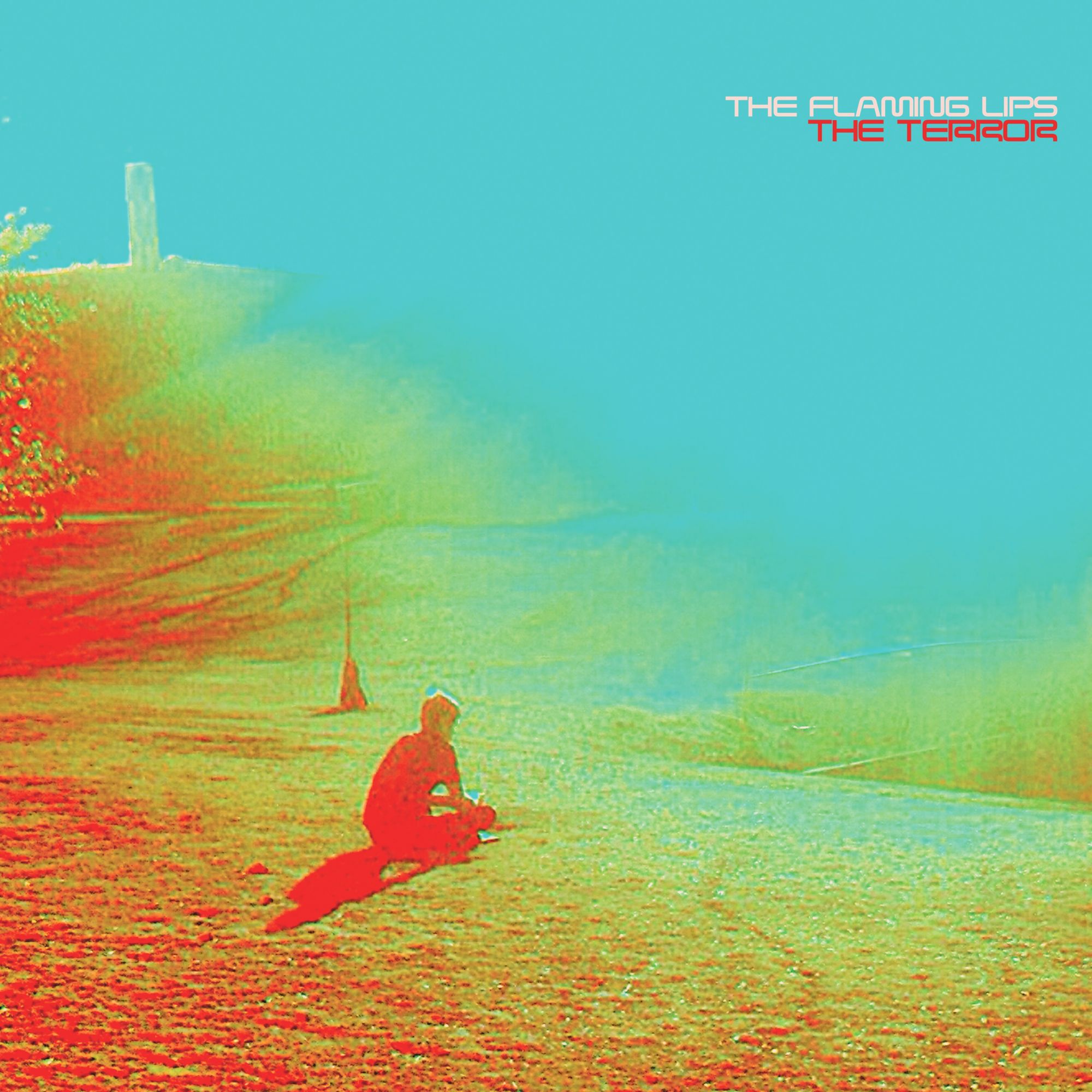
REVIEW: The Flaming Lips’ The Terror
When the Flaming Lips released In a Priest Driven Ambulance, I was a trembling fetus nestled in my mother’s womb. When I was nine, the band was radiating mainstream attention, but I didn’t know because no exceptionally cool third-grader brought The Soft Bulletin to show-and-tell. And when I was 12, Yoshimi was battling the pink robots while I was battling… well, puberty.
It’s been thirty years since the band’s inception, and it never occurred to me that the Flaming Lips are getting old.
And how could it? Last year the Flaming Lips’ collaborative album, Heady Fwends was one of my 2012 favorites. In 2009, both Embryonic and the covers of The Dark Side of the Moon completely changed my perception of the Flaming Lips by rocketing out of pop and floating into an experimentally psychedelic galaxy of psychosis. Seeing them live at Piedmont Park in 2012 was an even more electrifying experience than seeing them live at Bonnaroo in 2007. Chronologically, everything they’ve done has been an acclaimed next step in a new direction— so when Wayne Coyne described the upcoming album as heroin new wave at a funeral for aliens, I was ready for abduction.
But during the slow wait for their upcoming album, The Terror, the Flaming Lips were featured in a Hyundai Super Bowl commercial, and hit me. “They’ve passed their peak,” I thought to myself. “The Flaming Lips are on the downward slope of their musical career.” They were selling something to us on a commercial, and it wasn’t even theirs— and it wasn’t even art. The self-proclaimed freaks were trying to sell us a car? I couldn’t fathom it, and betrayal is a bitter drug.
But it wasn’t just the fact that they were selling Hyundai. The irritatingly peachy song they used for it was a perfect fit for a car commercial— it’s the equivalent to Robin Sparkles’ “Let’s Go to the Mall” covered by indie-headaches, Passion Pit or Vampire Weekend. “Sun Blows Up Today” is definitely the most uncharacteristic Flaming Lips song ever recorded. My face contorted with grief as I saw a sneak peek of the commercial online, and with disgust as I saw it like millions of others on the television screen. As a follower who once went full freak-out during a fleeting interaction with Wayne Coyne, I was writing off the Flaming Lips.
But as any true fan, I couldn’t stay away. I couldn’t actually write off an album I was so recently certain would blow my mind into cosmic explosion. No, of course I jumped to listen to The Terror as soon as I could. It’s Flaming Lips!
And I’ve gotta say it. Even though I don’t agree with the commercial, I also can’t say it directly affects the quality of their music. Sure, “Sun Blows Up Today” might be as excruciating to endure as the sun actually blowing up, but guess what— it’s a digital-only bonus track that sounds nothing like the rest of the album. We can handle this, we can disregard it, we can delete. The commercial-ridden track, as well as any low expectation you have for The Terror, can and should be dissolved.
That being said, The Terror isn’t the best Flaming Lips album, or the second or the third. What The Terror is, however, is a total eclipse of Flaming Lips ideology.
It’s almost like NASA told the Flaming Lips that they could finally live in outer space, but that each member must travel in their own separate spaceship. And after each member is launched into the cold, dark blanket of stars and mystery, the Flaming Lips simultaneously realize in a sudden state of agoraphobia that space-travel isn’t what they had expected. Instead, while hyperventilating into their spacesuits, the Flaming Lips become painfully aware that that life in space is like an eerie post-death experience of existence in an abyss.
The Terror takes fans in a totally different direction than previous Flaming Lips albums. With its seamless structure, it both absorbs and isolates in an atmospheric experience that somehow soothes yet scares, and makes the listener completely aware of silence.
In other words, The Terror is pretty close to a parallel of Radiohead’s Kid A.
Kid A begins with the sorrowful “Everything In It’s Right Place,” balancing chaotic alien-like background noises against a slow rhythm. The Terror begins with “Look… The Sun Is Rising”’s high frequencies, glitches, and smooth, echoing human vocals.
Where “Everything In It’s Right Place” feeds into “Kid A,”’s robotic lullaby of mechanical vocals, “Look… The Sun Is Rising” also leads into the hollow-sounding “Be Free, A Way” filled with cherub lingering vocals against short repetitive chops like a helicopter propeller.
Kid A peaks as “Kid A” becomes the sonic-storm of “The National Anthem,” while “Be Free, A Way” extends its likeness into “Try To Explain,” which then becomes the thirteen-minute peaking “You Lust,” spaciously spitting vocals repeating “Lust to succeed” between creepy, paranormal ringing-sounds.
“The National Anthem” then recovers into the most isolated and serene tracks, “How To Disappear Completely” and “Treefingers,” while “You Lust” spills into the most remote-sounding track, “The Terror” and then the schizophrenic “You Are Alone.”
Kid A picks back up after “Treefingers” with the The Bends-reminiscent “Optimistic,” and on The Terror with the higher-energy “Butterfly (How Long It Takes To Die),” similar to the tracks off Embryonic.
“Optimistic” then becomes “In Limbo,” which drowns the listener with waves of haunting harmony and vocals repeating “you’re living in a fantasy,” and then into the more electronic kick of “Idioteque.” On The Terror, “Butterfly (How Long It Takes To Die)” becomes “Turning Violent,” which hypnotizes the listener with distant vocals and close shaky, industrial sounds.
Closing in on the album, “Idioteque” transitions into “Morning Bell,” which repeats “cut the kids in half,” and into the melancholy dream-like, “Motion Picture Soundtrack.” Meanwhile, “Turning Violent” becomes the almost chanting, nightmare-like “Always There… In Our Hearts.”
Kid A ends in minutes of silence, while The Terror ends with a moment of echoing feedback.
Wayne Coyne may have said that The Terror is like a funeral for aliens, but I disagree. Kid A is more like a funeral for aliens, but taking place on Earth. The Terror is more like a funeral for humans, but taking place in space— mourning their own lives lost in a vacuum.
Outside of that vacuum and despite the commercial, The Terror echoes that the Flaming Lips haven’t begun the downward slope. Instead, they’ve embarked on a haunting and sorrowful journey that I can only imagine depressed astronaut Elton John would completely empathize with. It’s lonely out in space, man.
SHOW REVIEW: EOTO at Georgia Theatre
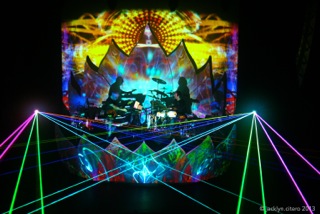
 On the eve of a month that many of us consider to be the start of the season of spring, a flower was in full bloom. Instead of promises of warmer weather, the blooming spectacle of EOTO’s iconic lotus flower stage promised concertgoers a night of seemingly endless body-moving jams. The duo, comprised of Jason Hann and Michael Travis, both members of the acclaimed jam band The String Cheese Incident, played the Georgia Theatre in Athens on February 28. The electro-jam show was a complete improvised, free-formed, and live mixed party.
With anticipation for the main act growing, opener Crizzly and his MC took the stage with high energy that translated through the receptiveness of the crowd. Between the bass drops and familiar hip hop samples, Crizzly’s set of “crunkstep” enthralled the audience and the party started — the night could only go up from there.
 As Hann and Travis took to the lotus stage, a welcoming roar of the crowd filled the theatre. The set began with down tempo jams and complementing visuals as the lotus flower morphed with colors of pinks, purples, and blues. It wasn’t long until EOTO was building the crowd up through a fusion of jam and dubstep. In addition to the inevitable bass drop that was to come next, EOTO pleasantly surprised the crowd with laser visuals. This use of lasers and the manifestation of psychedelic images on the lotus set the tone for the rest of this livetronica set.
Travis’ use of his MacBooks, software, keyboards, guitar, and bongos, and Hann’s drumming and vocals kept the audience on a unstoppable trip of funky heavy house music. With a steady energy of builds and drops, Hann’s spitting freestyle was added into the equation. Throughout the night, the music of EOTO was constantly evolving and maintaining a pace that left the crowd constantly wanting more.
The set progressed into a blend of something I can only define as Arabian reggae–sounds of the Middle East fused with slow motion grooves and island vibes. This journey of worldly sounds eventually blasted off into a raw spacey trance with an accompaniment of mesmerizing visuals. Heavy bass and a fast tempo throughout the rest of the show kept the crowd continually raging until the very end.
With the end of the encore and the house lights of the Georgia Theatre turned on, a disappointment swept over many in the crowd that night. A disappointment because the intoxicating transcendental escape from reality was over.

SHOW REVIEW: Tame Impala at the Georgia Theater
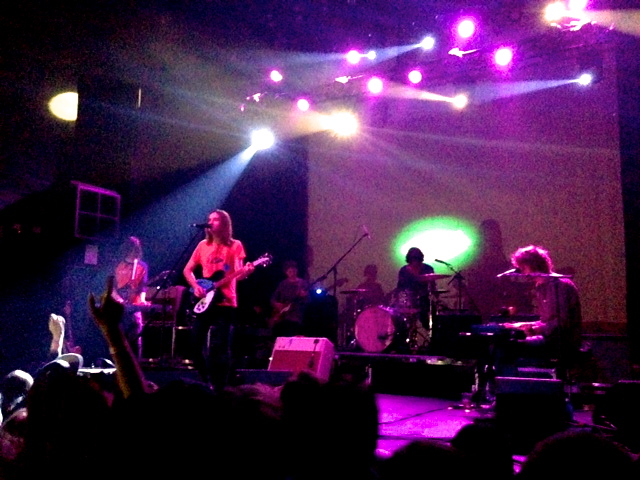 Some concertgoers can’t get enough of upbeat, high-energy shows that keep them dancing all night. Others prefer a more laid-back musical environment, one in which they can simply bob their heads and let the music soak into their skin. We give you the best of both worlds: Australian fivesome, Tame Impala. Their show at the Georgia Theater in Athens on February 23 was a constant mix-up of both types of tune – one song heavy and bouncing with the energy of a thousand guitars, the next transcendently mellow.
As the band walked onstage and began to play, we couldn’t refrain from thinking that their outfits – tee shirts, jeans, sneakers, and shoulder-length mops – were a bit reminiscent of a high school band. But once the steady drumbeat ushered in “Apocalypse Dreams”, all thoughts of amateurism vanished immediately. The crowd was swept into a psychedelic, undeniably Jefferson Airplane-esque paradise, and instinctively swayed happily in unison. The band and audience gained speed through the next few songs, along with the screen behind the stage, which warped from simple, colored lines pulsing to the beat to undeniably 60s-inspired, exotic rainbow patterns. This energy peaked with “Elephant”, arguably Lonerism’s catchiest track. As lead singer Kevin Parker crooned in that oh-so-John Lennon-ish voice, “Well, he feels like an elephant, shaking his big, grey trunk for the hell of it…”, we were all pushed over the edge into an earful of blues-y perfection that we couldn’t help but move to.
Soon, Tame treated us to a trio of our favorite tracks. With “Feels Like We Only Go Backwards”, the insatiable toe-tappers in the crowd became smooth sailors on a wave of chill psychedelia. When repeated whisperings of, “Gotta be above it, gotta be above it…” introduced Lonerism’s first track, though, the audience began undulating excitedly all over again, feeling Parker’s inspirational lyrics washing over us. Finally, the band transferred us to Haight-Ashbury circa 1967 during “Mind Mischief”, a tune with a very – well, there’s no other way to properly sum the vibe up – cool guitar sound.
Tame finished up with the upbeat, drum-focused “Half Glass Full of Wine”, and after an incredible, lengthy jam session – and this comes from someone who typically can’t stand when live bands jam – those at the Georgia Theater were begging for an encore. Thankfully, the crew came back for “Nothing That Has Happened So Far Has Been Anything We Could Control”, a very optimistic song with some unabashedly dark lyrics. I have to say, though, that our moods as we were leaving were much more similar to the song’s mood: as we exited the theater, we felt like we were floating atop a mind-bending whirlpool of rainbow-bright colors and dynamic sound.
REVIEW: Dana Swimmer’s Veloce
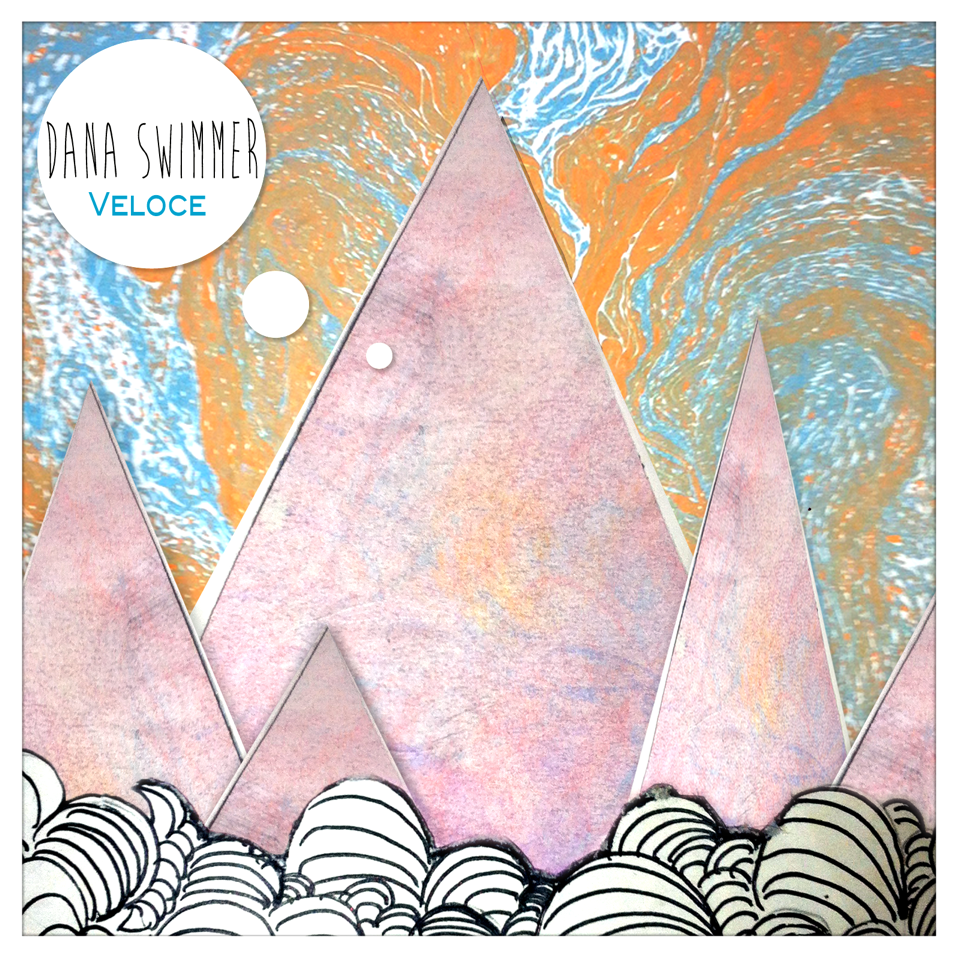
As someone living in Athens and happily soaking up all the music that this Classic City has to offer, I can say one thing without hesitation: Athens band Dana Swimmer makes me proud to be here. Their new album, Veloce, is an eccentric intermingling of rock n’ roll sounds that everyone and their mother adores – think the Black Keys – and personal touches throughout that remind you that this talented band is human and, well, undeniably Southern.
An example? At the end of the album’s second and most popular track, “Fairground Girl”, the band can be heard exclaiming such self-deprecating comments as, “That was awful. That was terrible!” These kinds of witty, sarcasm-imbued statements throughout the album harshly juxtapose what we’re thinking: “Wow, this song is AMAZING.” Speaking of “Fairground Girl”, we’re not surprised this song is so popular. It combines upbeat, pep-in-your-step instrumentals with a very Devendra Banhart-esque, crooning voice. It’s safe to say we can’t get enough.
And though the whole album is worthy of some serious Athens pride, the best track has got to be “I’m Still Your Man”. It’s slow, it’s simple, it’s beautiful – a love song to compete with the greats. The tune really peaks at the chorus when some very whimsical female vocals are introduced, that later morph into entirely fitting background vocals.
Yet another endearing feature of the album, the 29-second instrumental “Tilda”, brings us to the album’s last two songs. And, have no fear, Dana Swimmer is clearly not the type of band to haphazardly stick a few songs on the end of an album to kill time – these last tracks are some of the band’s best. “Mother Nature” is decidedly hard and fast, reminiscent of the Eagles of Death Metal or the Strokes. The album ends on a bit of a lighter note with “Signs of Symmetry”, a playful, upbeat tune, mixing in a few retro ooh and aahs for good measure.
So, are you dying to be an Athenian yet?
8/10

REVIEW: The Bronx IV by The Bronx
After much anticipation, Los Angeles punk rock band The Bronx has broken a five-year musical hiatus and released its fourth studio album, The Bronx IV, which dropped today. The Bronx has been an underground staple in the hardcore scene for over a decade, and this record seems to pick right back up where the band left off, with four of the five founding members still on board and the addition of (bass guitarist) Brad Magers, who joined back in 2007.
The Bronx has shared the stage with artists like Fucked Up, Mastodon, and The Refused, and the band toured the 2008 Vans Warped tour in its entirety. To add to the rad, their side project, Mariachi El Bronx, has been recognized by The LA Times, NPR, and Pitchfork (and, of course, Vinyl Mag). Clearly these guys have been doing something right – and this album is no exception.
Opening up the album with “The Unholy Hand”, The Bronx IV retains every bit of high energy that these guys have exuded for years now, religiously “metaphorizing” the price you pay for success with their lyrics “Are you the Anti-Christ or the Holy Ghost? Do you want to die or just come real close?”. The album then smoothly transitions into the second track, “Along For The Ride”, which sings of settling into the familiar, reflection of the past, and complacency as a whole.
Track 4 on the album, “Youth Wasted”, jumps right back into reflection mode, opening the track off with “The truth is, the truth still hurts”. There’s no arguing that, is there? “Sometimes the best laid plans will still end with blood on your hands” makes up almost the entirety of the song, but somehow the repetition is appropriate.
The energy of the record maintains its old-school, fast-paced feel with the following tracks, “Too Many Devils” and “Pilot Light”, but then it delightfully flips the script with the seventh track, “Torches”. As a whole, “Torches” is notably slower than the entire album, setting a somber tone and bringing you back down a few notches on the intensity scale that the first half of the album inevitably carried you to. It signs off with one quote-worthy phrase: “You cannot change the life you want to live”.
Aside from “Torches”, the album continues to pay tribute to its punk rock origins, keeping the pace amplified and the lyrical content brutally honest.
If I were to guess, the 12-song eponymously titled album will please and appease the former fans and (undoubtedly) attract some newbies. In the day and age of musical rebirth from album to album, there is something refreshing about a band that continues to stick to their roots and what they know. Punk rock personified is probably smiling down (or up) from somewhere right now knowing that hardcore is in fact not dead, but rather very much alive.
REVIEW: Ladyfinger (ne)’s Errant Forms
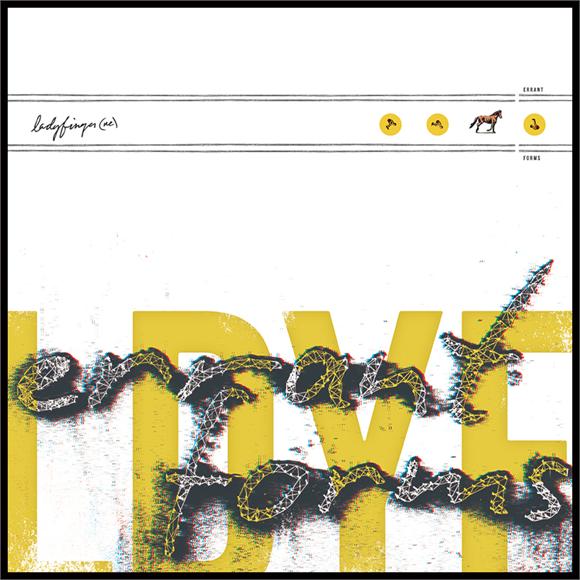
 Ladyfinger (ne) occupy a strange locale between punk, post-punk and FM rock. Nothing truly gets sketched out, but that seems to be Ladyfinger (ne)’s objective here. In their own words, they describe pulling inspiration from early 70’s classic rock. But that label is a bit of a misnomer, because Errant Forms sounds nothing like the 1970’s. Nor does it necessarily sound like any other decade, and that is Ladyfinger (ne)’s selling point and ultimate downfall. Errant Forms cherrypicks from various rock and roll derivatives from the past twenty years, and the result is sometimes rewarding and oftentimes frustrating.
Frustrating firstly in that Ladyfinger (ne) will deploy a serious tease by initiating a track with a sonically diverse introduction only to have the song swiftly switch gears to make way for a stifling and forced opening verse. If this sounds specific, take a listen to the album’s second half. The two most devastating fake-outs are “Poison for Hire” and “Meathead,” and it’s worth noting these two stand with some of the most lyrically trite works on the album. Both intros to “Poison for Hire” and “Meathead” illustrate Ladyfinger (ne)’s greatest strengths: rhythmic complexity, frenetic guitars and a knack for building tension without giving anything away too soon. But like a left hook to the jaw, Ladyfinger (ne) cut the intro and rip into the first verse. Different tempo, different style, different everything. The sloppy editing is disappointing mostly because it highlights a possibility Ladyfinger (ne) could embrace instead of spending their time writing songs about the insecurity felt in the presence of machismo.
And that is Errant Forms’s second most frustrating aspect: the cheeky lyrics. Singer Chris Machmuller has a special habit of preaching and confessing a little too much in his lyrics. The big stinker here has to be “Galactic,” in which Machmuller outlines a possible conspiracy theory involving aliens. As a joke, it isn’t very funny. As something serious…well, it still isn’t funny.
Errant Forms shines when the instrumentation has room to breathe and expand and the rigidity of its pop structures falls away. Moments like these are few and are usually ruined by troubling lyrics, but these brief flashes of intriguing experimentation illustrate a band with the sensibility to rock but the hesitation to find a voice.
Top Tracks: “Renew,” “Birds,” “Blue Oyster,” “He Said She Said”
5/10