
Tag: Deerhoof
Warning: Attempt to read property "post_id" on null in /dom375187/wp-content/plugins/enhanced-category-pages/classes/ecp/Enhanced_Category.php on line 143
Warning: Undefined array key 0 in /dom375187/wp-content/plugins/enhanced-category-pages/classes/ecp/Enhanced_Category.php on line 232
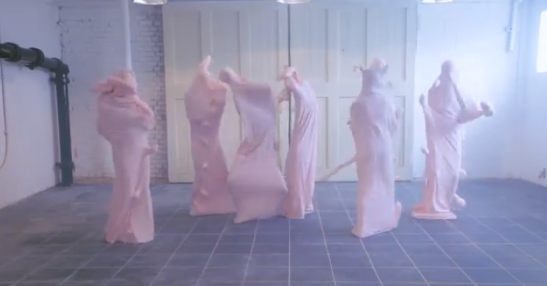
Watch: Deerhoof: “Paradise Girls”
Not entirely sure what I’m watching, but I’ve watched it at least five times already.
Tuesday, rock band Deerhoof released the video for their latest single, “Paradise Girls.” The song appears on their full-length album, La Isla Bonita. While the song seems to have a focus on the instrumentals with hardly any lyrics other than the same chant of “giiiirls” and “you are smart” among other little snippets, the video is extremely intriguing. For one, there are girls prancing around in costumes that look similar to the creature in that movie “Slither,” and there’s a primary woman throughout the whole video who has some incredibly bright eye shadow and lipstick.
She prances and dances around singing the three-four chants – to a dance-provoking beat that reminds one of tUnE-yArDs – while the others looking like Teletubbies rolling down a grass hill. In a turn of events, the girls give birth to themselves in a sense, breaking their heads out of the cocoon that they were fully wrapped in.
Needless to say, the video will make you stay, the music will make you replay, and the dance moves will drive you…cray.
Check out Deerhoof’s “Paradise Girls” below, and check out their new album, La Isla Bonita via iTunes!
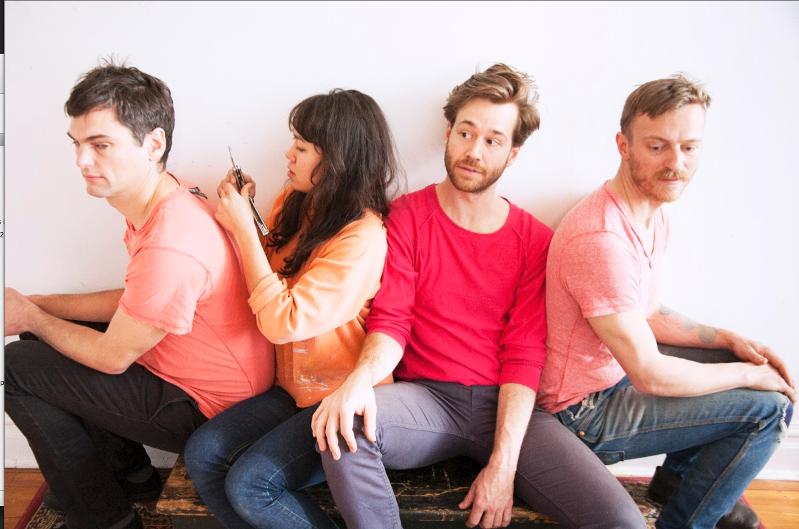
SHOW REVIEW: Deerhoof, Liam Finn, Tunabunny, Formica Man
An unusually large lineup and an (almost) appropriately large crowd convened at Athens, Ga.’s 40 Watt on Saturday, Nov. 10. Formica Man and Athens natives Tunabunny delivered energetic sets, but it wasn’t really until über-bearded New Zealander Liam Finn took the stage that things started to fill in on the floor. An impressive showman, Finn managed to keep the audience engaged through every second of the floor-bound fiddling and fussing that comes with being a one-man band.
Maybe it was because the music itself actually delivered. Finn’s tunes were chord-y and emotive, at times harkening back to the mid-90s golden age of guitar alternarock. But even if each song appeared to fit a template at first, there was almost always a twist. In addition to his trusty looper, Finn deployed an armada of octave machines, flangers, dirt boxes and every other pedal you can think of, always to good effect. Instead of merely overdriving guitars to make them louder, he would find compatible timbres and blend them to create new flavors of resonance. You get the sense that some of this stuff could be achieved more easily by pressing a space bar. But Finn’s the kind of guy who’d rather work for it, even relying entirely on live percussion played by you-know-who. He displayed impressive chops on the kit, even managing to rearrange loops with a spare foot during the infinitesimal moments between kick drum hits. By the time he delivered a personalized tune about being an “Athens virgin,” Finn had won over just about everyone in the room.
Then, with gracious speed, Deerhoof filed onstage. There were cheers.
Listening to their records, it’s not hard to glean that this group rarely wants for ideas. But in a live setting, you also realize what a staggeringly talented collection of musicians they are. While there weren’t any warp-speed, Steve-Vai-sanctioned guitar solos going on, the members’ understanding of rhythm – and the many ways in which to turn it on its head – was borderline virtuosic, improbably calling to mind the technical prowess of nerdier bands like Battles and the Mars Volta. On innumerable occasions throughout the set, Deerhoof veered off into time signatures so odd and unexpected, it was like watching a troupe of trapeze artists pull off stunt after stunt. And all night they did it without a net: shaggy drummer Greg Saunier roughs it on a spare three-piece kit, confidently tossing off the chance to bury mistakes beneath a mound of blurry tom fills.
But don’t worry: Deerhoof aren’t going to write any hour-long prog operas anytime soon (I don’t think). Despite the pronounced “jankiness” of their rhythmic engine, the true unifying force behind their live show is a strong dedication to the ethos of straight-up rock. There is ample noise and energy, and all the combinations of loud-soft/fast-slow shakeups that render each full-band crash absolutely huge. They’ve nailed these devices, skillfully conjuring and combining them at will. And above all, the performance was expressive, a quality that seems to slip the minds of many equally nimble musicians. Throw in the robotic pixie dance moves of frontwoman/bassist Satomi Matsuzaki, and you have a show that’s just weird enough to fascinate while precluding any accusations of gimmickry. Deerhoof may be an against-the-grain act, but they’re too focused a unit to fall back on faux-showmanship.

Greg Saunier of Deerhoof interview
Despite what you could maybe call a bit of inclement weather – Hurricane Sandy tore through New York City just as the band’s tour was supposed to begin – Deerhoof have made it out onto the road to support Breakup Song, its latest release on Polyvinyl (the label). Vinyl (the mag) was fortunate enough to catch up with drummer Greg Saunier a week before the tour’s kickoff show in Dallas.
__________
Vinyl Mag: A lot of people experienced the new album for the first time through the Youtube video that was all one track. As a result, I can’t get it out of my mind that the album almost is one big, long track, composed of various movements.
Greg Saunier: While we were making [Breakup Song], I had deejayed some shows – before the band played and then after – and they would turn into dance parties. I had only ever thought in terms of “what’s going to make it sound like a great album?” But the idea of an album, as a format, is not even as popular a format nowadays. It’s much more likely that you’re hearing a sequence of unrelated singles, and the only thing that relates them is that they share the same roomful of people, and there’s room to dance. If you want it to be danceable, it would be pointless to put in even one song that’s not danceable. You’d have to start over again from scratch. This is something that really struck me, and I kind of learned it the hard way while I was deejaying [laughs]. It was a fun thing to realize, and we tried to sequence [the album] as if it were a continuous party, and that’s why there are no breaks between songs – you don’t want to let it flag even for a second.
Even though the songs all sound quite different from each other – that in itself isn’t meant to be arty; that’s just how it sounds the way the party gets deejayed. You’re switching from artist to artist, most of the time. In my case, you’d put on one song from Motley Crüe, you’d put on one by the Zombies, and they’re all danceable.
VM: So you’re trying to work within your own vernacular, but trying to find every disparate corner in the same little room.
GS: Yeah, exactly. Dance music doesn’t have to mean disco … When we decided we wanted to make a dance record, we ultimately ended up with no songs that were like that. We ended up cutting everything that was in a disco vein. Dance music is still very wide open – you can feel like it’s a limit on what you’re doing, but really it opens it up even more. If you’ve got one dance song on your record, then, boy, you’d better make it a disco song. But if every song on the record is dance, then you suddenly realize the range of what that can be. A lot of it was kind of a heavy metal approach to dance music, and that’s not normally thought of as dance music, but when you listen to early Motley Crue, or the Scorpions, or something like that – of course it’s dance music. One of my favorite songs is “Come on and Dance” by Motley Crue, actually, and people started moshing to it when I played it at those dance parties. It is danceable.
Then we got into trying to do stuff influenced by Cuban mambo music from the 50’s. It’s not the kind of dance music where you sort of space out; it’s not like a rave. It’s much more starting and stopping; it’s very tense-sounding. There will suddenly be a pause, and then some guy yells, and then it starts again. It doesn’t flow; it’s almost stiff-sounding. I just completely fell in love with that over the past year or two and was trying to think of how that is dance music, and how we could make music that has something like that quality.
And then, last summer, we played in this big supergroup with a bunch of musicians from the Congo like Konono N˚1. We did a tour in Europe last summer with them. That was basically dance music, too. The show would be up to two hours of basically dance music. There were all these things I learned to play on the drums from playing with them that were very different from anything I had ever done before. I started playing stuff that was a lot more repetitive, and kind of a lot simpler. Once my hands and feet started being in the habit of playing like that, it changed the way I played a bit, too. So I think the album turned out different, as a result.
VM: Those briefed ahead of time on the dance-heavy nature of the record were probably expecting something closer to the four-on-the-floor disco thing you mentioned earlier. Yet it’s obviously nowhere near that area.
GS: There’s a second in “Mario’s Flaming Whiskers III” that I think has a bit of that – a bit of house beat to it. That was Satomi’s [Matsuzaki, Deerhoof bassist and vocalist] song, and she wanted a house beat on that one. But other than that, it doesn’t sound like disco or house.
VM: Do you find it liberating or limiting – or maybe even both – to be known as a “weird band”?
GS: [Laughs] In our actual day to day existence – like when we’re on tour, for example – I think that’s something that comes into play when journalism enters the picture. When we have a new release, journalists often want to describe it that way. Or sometimes it happens with booking. When a tour is first being set up, it’s like, “Okay, we’re going to play in Athens. Where should we play? Who should we get as the opening band?” A lot times the promoter will be like, “Who’s the local weird band? We should get the local weird band.” [Laughs] But the thing is that, yeah, I see that, but in a way it doesn’t touch me, because by the time we show up in Athens, what I see is people dancing, I see people with big smiles on their faces, and where it fits in in some kind of music blog or music history book is the furthest thing from anybody’s mind in the middle of a loud rock show. I don’t think of my music in any category, and I feel extremely liberated. Sometimes I feel limited by my own creative limits or my own abilities to play the drums, but I just see that as a challenge all the time, and try to trick myself into finding something new that I didn’t know I could play or write.
VM: You guys have managed success in two different eras. When you were starting out in the nineties, it was more the era of records sales. Now we’re in an age where you’ve got to keep the touring machine going. How have you managed a smooth transition between the two?
GS: [Laughs] Sorry, the reason I laugh is because it was in the nineties – the quote-unquote era of record sales – that we sold no records. It was like, from 1994, when we started the band, to 2000, it wasn’t like no records sold, it was just that not enough sold to ever break even on anything. I’ve got to give Kill Rock Stars credit for putting out our albums. For the first seven years of the band, everything we put out lost money. I’ve got no nostalgia about the good old days [laughs]. That doesn’t exist for me. It exists in that I knew it was true for some of my friends, but it was never true for Deerhoof.
As much as we do like putting out LPs – and I like colored vinyl, and we put out cassettes of our last two albums, and for this last album we put out a book of flexi-discs – deep down, I have never cared that much about format. And it’s just me; I’m not even speaking on behalf of the whole band. On behalf of Deerhoof’s drummer alone, I have never cared about format … I’ve been happy that our music is available in this other format, the mp3. Or, like you were pointing out, not even the even the mp3, just a Youtube video, which you can’t even download. It’s just something you press play on, and then you can either watch it or not watch it, but you hear it playing in the background. As a person in a band that always does something special for Record Store Day, and who has always been on indie labels that are heroic, I think – Polyvinyl and Kill Rock Stars, I think of that way, heroic in that they even continue to exist in the face of a very difficult market – I’m not the best mouthpiece, honestly. If record labels cease to exist, and physical formats end tomorrow, we will still be a band. We would still make mp3s and still go on tour. I feel like a very successful band in that we are still playing and we still love playing. In fact, we love playing now more than we ever did. As far as living through two eras … I plan on living through a lot more than two. I plan for the era to come to put the previous two to shame.