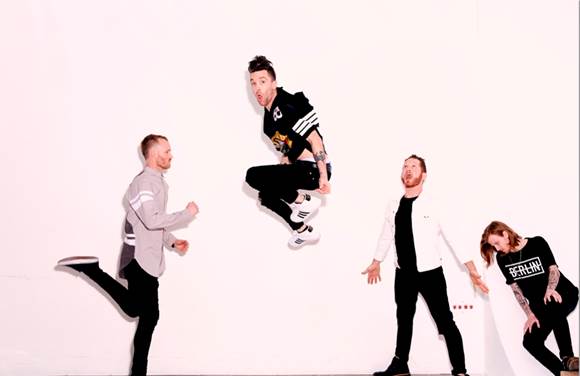
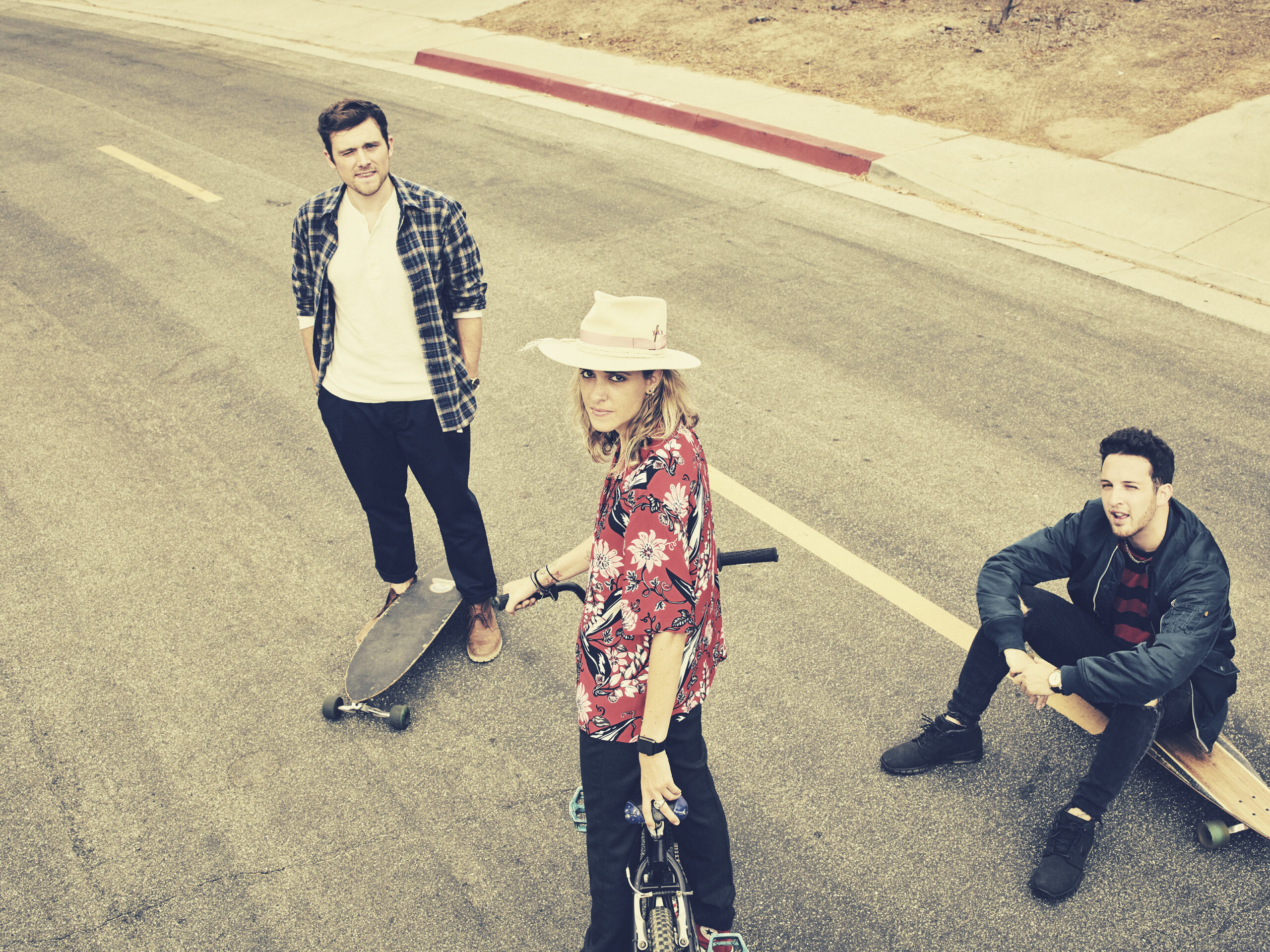
By tomorrow, bands and their fans will be swarming Atlanta, Georgia for the Shaky Knees Music Festival. On Day One, listeners will get a chance to hear Zipper Club rock the Peachtree Stage at 1:00 p.m. at Centennial Olympic Park.
Zipper Club may make indie pop music now, but the band members didn’t start out that way. Mason James hails from the Brooklyn punk band Cerebral Ballzy, and Lissy Trullie had her own killer indie-rock career. Now, however, the two have joined forces, working alongside drummer Damar Davis and producer James Iha of Smashing Pumpkins.
To gear up for their Shaky Knees performance, we chatted with the three musicians all about their latest tunes, what makes them unique, and even what makes them panic.
Vinyl Mag: Tell me about your song “Regrets.”
Mason James: I was writing it in a room actually with my dog at the time, and it’s kind of funny—you can hear my dog scratching his stomach or his chain jingling, and I think it kind of adds a little subtle dog vibe. That was a really cool track for me because I got to experiment with some new stems that we had, and that was kind of a definitive song in the songwriting process for the band. It was a very definitive song for kind of the direction of the sound we wanted to go. The process for the record was kind of written in three groups of four, and that was one of the initial songs that was written. And that song kind of shaped where we went from there—“Breath” came out of that and other stuff afterward.
VM: You’ve said before that Zipper Club’s style is a bit different from the music you’ve made before. What inspired the change?
MJ: I wanted to try new things! I definitely felt a little bit confined—punk and hardcore music can have a lot of rigid boundaries and a lot of people telling you what it is and isn’t in that genre, and I kind of just wanted to say, “screw all that stuff; I want to make what I think sounds cool.” So, if I want to put some weird sounding synth pad or some chimes or some bells or some reverb guitar, then why not? And that’s kind of what we did.
Lissy Trullie: My style of songwriting is not such a leap. Mason played in a punk band; I had my own thing, which is like still sort of pop-ish. It was more experimental and R&B. But I think it was both for us a combo to do something new.
MJ: Lissy and I came together and had a lot of the same mutual respect for a lot of the same bands, and kind of did draw on those influences. So, as a result our sound kind of meshed, and we’re able to collaborate in an awesome way.
VM: What does each of you bring to the table?
LT: I think we just bring our special selves! That’s kind of half the battle, especially when you’re writing together. You know, inevitably you have a view from yourself, a perspective, your voice, your inherent style of what you do. But I think if we’re talking skillset, writing music is my jam. It’s my favorite thing to do. It’s what I’ve always done and what I absolutely love, love, love to do. I love to be in the studio and play around with ideas and experiment with different things.
MJ: I think we’re all very different individuals in a sense. If you go to certain festivals and stuff like that and you hang out backstage, you can see certain people in certain groups, and they all look very much the same in a lot of different ways. You know, they’ve got their matching outfits and all that sort of stuff. We’re definitely not that, and I think that’s what’s cool about this project. It’s much more reflective of the modern world, modern times. We all come from different backgrounds and different musical tastes and different styles. So, I think we all bring a unique aspect to the table that is different than most bands, and I think that’s the cool thing about Zipper Club.
VM: Do you prefer writing/recording or performing?
LT: We love both!
MJ: I think both have their awesome side, and I mean obviously there are not cool parts. I think every band that writes music should love writing music. We love writing music but also want to share it with people, and we try to share it very visually. Our live show is definitely very … we have lasers and have really cool projections and stuff like that. We want to make it an experience for everyone that’s coming out to see our show. We love sharing what we do with people. So, I think they’re both equally as good.
VM: Do you have a favorite venue you’ve played?
MJ: I’m excited to go back to this bar that we’re playing in London. It’s this really divey, shitty bar, but it’s super London and super fun. We’re playing there in a couple weeks.
VM: What part of playing at Shaky Knees are you most looking forward to?
LT: The Pixies, LCD Soundsystem and then I think my friend’s band is playing there—Public Access TV.
DD: I’m excited to see Phoenix!
VM: Do you have a favorite song to perform live?
DD: My favorite song to play live would probably be “Tick Tock.”
LT: I’m going to have to go with “Breath.”
MJ: My favorite would be our cover of “Mad World” we did with Curt from Tears for Fears. That was definitely an awesome live experience.
VM: What’s your mindset like before getting on stage?
LT: “Ohhhh, shit.” That’s my mindset.
DD: It really depends on how our soundcheck was.
VM: Do you have any pre-show band rituals?
LT: We do a little huddle thing. Of course, we always want to play and we always want to play a good show especially, but it really depends on the venue you’re at, and we have a complicated thing happening on stage. So, if we feel like something might not be in the right place, you know, it can really put us into a panic. But, we’re working on that!
If you loved Half the Animal‘s single “Babylon,” get ready to fall in love with a whole new layer of it, thanks to the acoustic version. Chase Johnson, Nick Gross, Evan Smith and Dan Graham are the voices behind this not yet one-year-old project.
We spent a few minutes with frontman Chase, and he filled us in on the (literally) colorful way he sees the new songs as well as the two meanings behind the band name. Check out the SHAPES EP, the acoustic video, and the interview below.
Vinyl Mag: So tell me a little bit about how this project came about.
Chase Johnson: Nick and I met in Catechism class when we were 14, and we’re 28 now, so a long time ago! We’d get kicked out on purpose to talk about music, and finally we just thought, “hey, wanna do a band thing?” I was like, “I sing,” and he was like “I drum.” I already had like a little group set up at elementary school. So, we started from there and had a band called Open Air Stereo for a really long time, did some great things with that. And then we took a break from Open Air Stereo, and it led to Half the Animal. We started writing all these songs, and we felt a whole new birth, a whole new sound for us, and it felt really good; it felt different. We felt new. We’re a lot less rock now, there’s a lot more pop-driven kind of stuff going on. So, we wanted that to pull through, and with Open Air Stereo there was a whole lot of rock stigma going on so we felt that a change was good.
VM: What’s the biggest strength that each member brings to the table?
CJ: We all have our strengths. Nick is the business mindset and an amazing drummer, obviously. Evan is the most amazing sound-tech guy that there is. He actually owns a production company for live shows. And he holds down the low-end obviously … everyone holds down their instruments. Dan is an incredible guitarist, and between me, Dan and Nick we all write a lot of music ourselves, for the band, for other people. Dan is an amazing writer–he’s always got his laptop and making beats, making everything—and we all collaborate on finishing the song. And then for me, I’m the crazy, outgoing lead singer, I guess! I keep getting pegged as that, but I guess that’s kind of what I signed up for. I always love talking to people and getting to know people. I love engaging with fans, and I love hearing their stories. And then I also do fashion/editorial photography, and I’ve done some photography for the band, too, and then I’m also a writer as well.
VM: How do you combine those strengths and backgrounds into a cohesive sound?
CJ: You know, I don’t know how we do it. We just do it, and it works. Even though Dan’s fairly new to the band and the project has only been around since July, there’s this cohesiveness because we’ve all done other stuff outside of it. We brought all of our experience to the table, and I think that’s a collective thing we have together.
VM: What’s the history behind the band name?
CJ: I have my own perception, and then Nick has his own. For me … I love researching human behavior, and I feel like everything in life—especially if you live a creative life—everything I’ve done well at has been a little bit off the cuff and making quick decisions and going with your gut, going with your animal instinct. We all have it–not in like a crazy person negative way, but in the positive way. Using that animal that you have in you to do great things in life is really important. So that’s what it is to me. For Nick, he has this buddy who does a bunch of broker stuff in New York–he’s a big business guy. Nick was on the phone with him one day, and he said, “Man, if I’m half the animal you are, I’m going to live a very great life.” So, those are the two ways that we rationalize it, I guess!
VM: I know you guys just released the SHAPES EP at the end of last month! If you had to describe it in one tweet, what would you say?
CJ: Each song on the SHAPES EP has its own shape and its own color. “Babylon” is blue, “Saturday Night” is bright red, “If You Want My Love” is green.
VM: What makes “Babylon” blue?
CJ: “Babylon” can be conceived to me as a love song or a struggle song or an empowerment song. I want it to be open to interpretation for everyone–if you’ve had a struggle with drugs, alcohol, love, just life in general. As we all know, Babylon was the most amazing, advanced, beautiful place, and it fell one day. It took a long time to build it, and then it fell. For me, there were some things going on in my life–half of it’s for the woman I was with for a long time and the other half is for some choices that I made that weren’t the best in life. It’s that whole thing of thinking that’s the most amazing thing in the whole world, oh my god it feels so good, and then it falls. And I don’t think there’s any gray area with blue, which I know is confusing because I’m talking about colors. But blue like the ocean–the ocean’s the best thing in the world. Blue can be a really good feeling, or blue can be like having the blues. It’s a bit of both. I’ve listened to the song before and was like, “Oh, that’s kind of heavy.” And then I listened to it again and think, “it’s uplifting!” It’s very moody.
VM: What made you choose that song for an acoustic performance video?
CJ: Other than it being the single, I think we would’ve chosen that song regardless, because it translates. We kind of do it a little differently acoustic to change it up a little bit to give it a new little bit of life. Bringing a new light to a song (especially a single) that everyone’s going to be hearing so much … it’s really cool to get a different viewpoint for it.
VM: Which version do you like better?
CJ: Personally, I like playing it all out live. I love it; it’s so much fun. I love acoustic music, but with my ADD I want to jump around all the time. But I’m kind of digging the acoustic; it’s fun! It was almost like a challenge for me mentally to do which is cool. I always accept a challenge.
VM: Would you say it’s your favorite song to perform live?
CJ: I do love to perform “Babylon.” I love playing “If You Want My Love” live; it’s so different. It’s a little bit more jazzy and kind of vibey, which I love. But live, I have a couple favorites. “Saturday Night” I like to play live and then a couple new ones that aren’t out yet that we play. We have one called “Shapes” that’s really fun that people are digging a lot, and then a song called “People in the Room.” But yea, I could say “Babylon” is a favorite.
VM: Which song was your favorite to write and record?
CJ: “Babylon,” absolutely. I got to get out some stuff.
VM: What do you hope audience members walk away with when they leave your show?
CJ: I hope they feel like they just saw a great music show. I hope they feel emotions from the songs … we just want people to feel good after they see us, and excited and definitely wanting more. We pride ourselves on our live show–we love to perform so we want them to feel good, great, amazing!
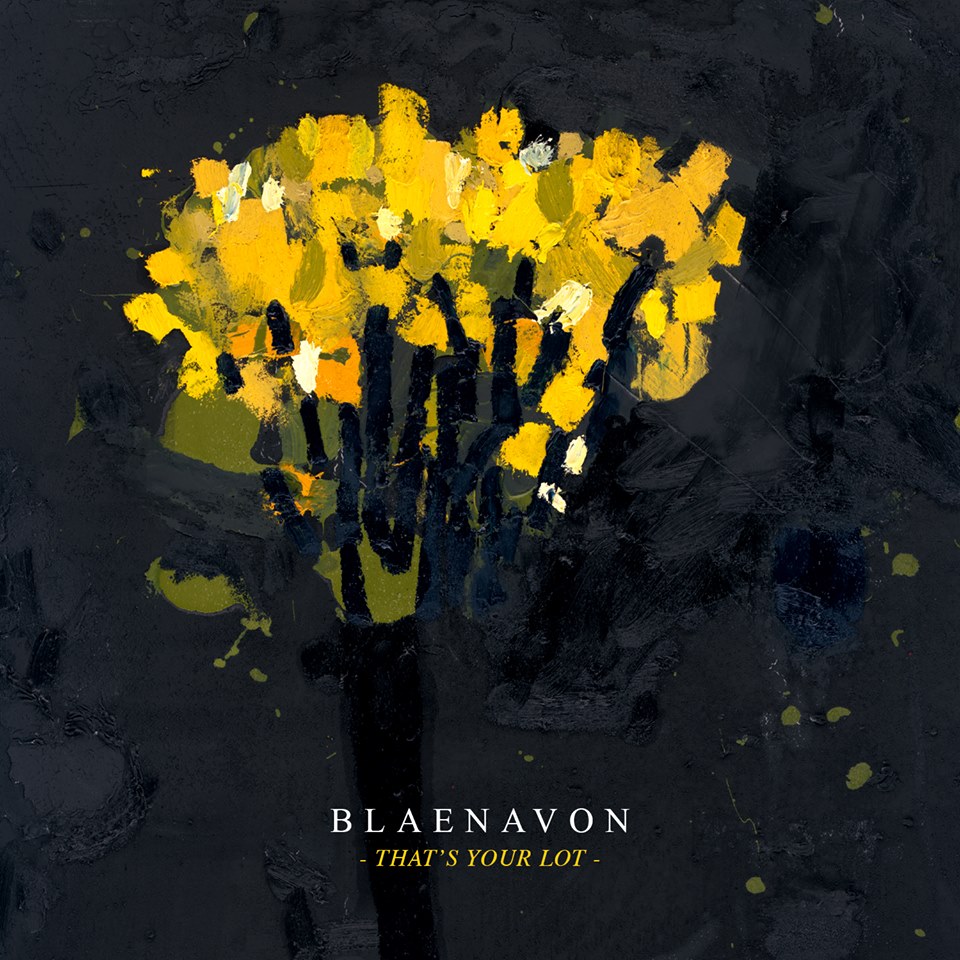
Today is a good day, because 1) it’s the weekend—TGIf, folks—and 2) Hampshire, England-based Blaenavon is dropping their debut album. That’s Your Lot, via Transgressive and Canvasback, is produced by Jim Abbiss (Arctic Monkeys, Adele) and is five years in the making.
Blaenavon released a few EPs after their very first single “Into The Night” hit ears all the way back in 2013. Since then, fanbase and anticipation for the trio’s debut LP have been steadily growing.
“That’s Your Lot is five years of our lives condensed into 59 minutes of yours,” said singer/guitarist Ben Gregory in a press release about the album. “Youth, capriciousness, duality, duplicity, love, bitterness, fate. Songs from the human core: some malleable, long considered—others pure, direct, cruelly honest. An album to bathe in and appreciate the inevitable end.”
The Tracks
“Take Care” serves as an upbeat introduction to the band if you haven’t met their sound before. They’ve performed it live a lot, and if the energy in the recording is any indication, the live version must be a party.
“Let’s Pray” takes you on a heavy lyrical journey. While the words may be somber, the refreshing honesty and energetic sounds come together in a balance of emotions. After belting out a few rounds of the words “let’s pray for death,” the band draws you into a chorus of “ooh’s” that will have you singing along in no time.
“Orthodox Man” may be the third track on That’s Your Lot, but it’s Number One in our hearts and hotbed of catchy melodies. Get ready for a groove of a bass line, because its presence is felt throughout the whole song. The repetitive lyrics in the chorus add to the catchy factor—it’s no wonder the band released it as a single. It definitely got us all pumped for the rest of the album.
From one headbanger to another, we move into “My Bark Is Your Bite.“ The guitar riff from the kickoff sticks with you and makes this song another contender for catchiest track. Conceptually, it’s also a winner. Gregory sings of lying because his “mind says it’s the best thing to do.”
In “Lonely Side,” the vocals hit immediately, and “in a land of parasites” is one of the first lyrical phrases you hear. Heavy. The chord progression reflects the mood with its minor emphasis, and though it starts out somber, it brightens up with the addition of vocals and synth.
It’s clear from the first few seconds of “Let Me See What Happens Next” that it’s going to pull on your heartstrings. Gregory’s vocals and a piano: that’s all you get, but that’s all you need. Simple chord progression, piano arrangement, vocal lines and harmonies—it works. In the midst of fully produced, guitar-heavy, percussive tracks, it’s nice to have a piano ballad to mix it up and provide a point of rest.
I’m a sucker for any song with a person’s name in it, so when I saw “Alice Come Home” on the list, I immediately began romanticizing. It builds slowly and launches after the first minute or so. Gregory switches his vocal style from airy to belting and back again to provide a rollercoaster of a song that’s dynamic and fun to follow.
“Ode to Joe” can only be described as “eerie,” a tone accomplished with a piano and what I’m picturing as a damp, dark echo chamber.
“I Will Be The World” has punctuating vocals that match the precision of the drums. The track escalates, forming one of the heavier rock song of the album and proving the trio’s range.
“Prague ‘99” suggests a trip around the world as well as back in time, and the song takes you on a high-energy run and into a room of groove. From the top, an intricate guitar riff is introduced, and then driving rhythms from the drums and more guitars are added to fill the landscape.
“Swans” is a lullaby with a dark side. It makes use of the eight minutes with a slow but steady build up to hard-hitting percussion and layered guitars.
Closing out, the title track, “That’s Your Lot,” rests at the very end. The band carries their less-than-sunny outlook to this melodic farewell, musing “I’m part cloth and part man.”
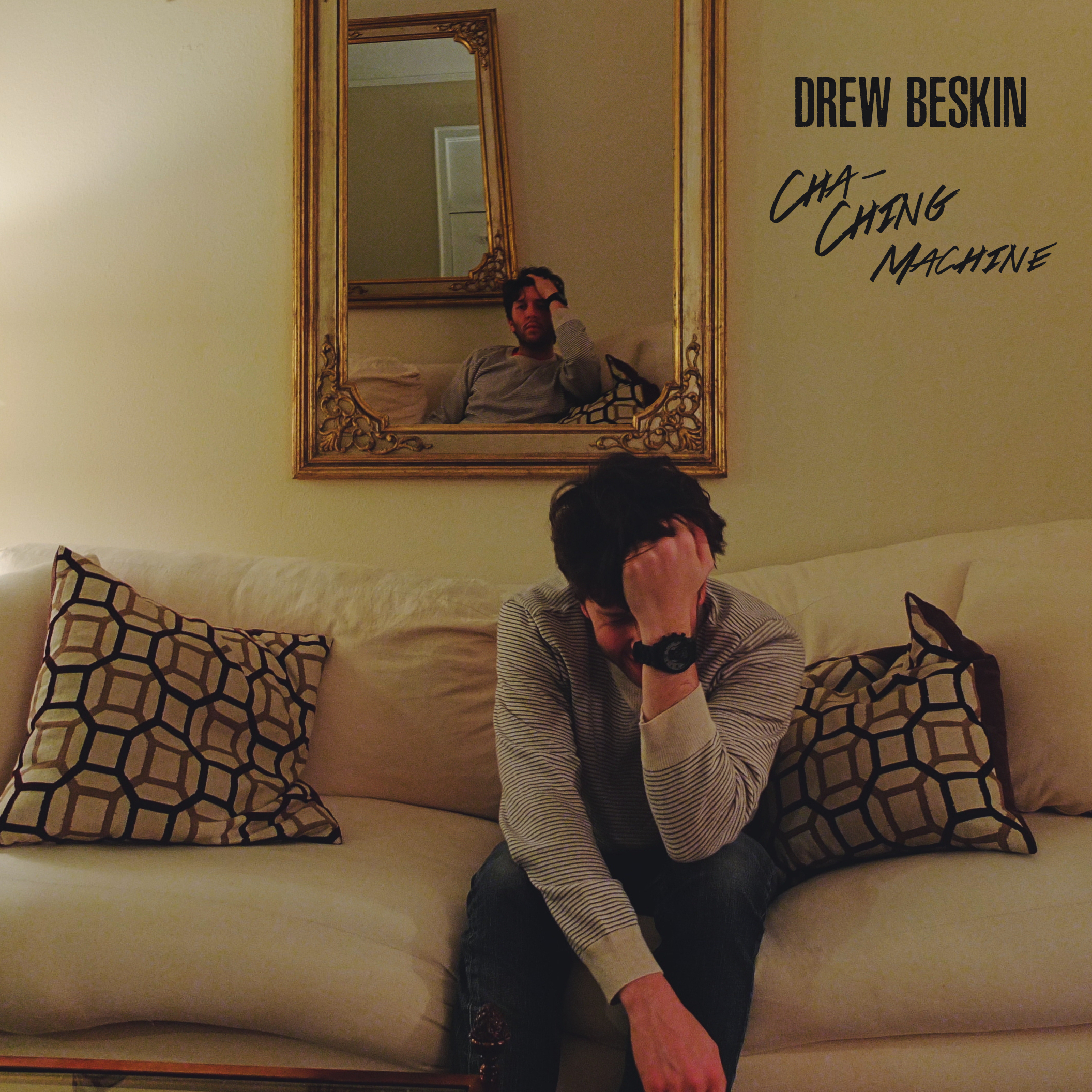
Drew Beskin has worn many hats. He’s been the frontman for the bands The District Attorneys, Party Dolls and PURSES, which have spanned Atlanta and Athens venues such as Smith’s Olde Bar and the Caledonia Lounge. He’s also been serving as the manager of the Georgia Theatre in Athens for the past few years. These days, however, he’s been working on a solo, self-titled project: an album entitled Cha-Ching Machine, out today.
Beskin teamed up with Chase Park Transduction (the Athens studio that’s been instrumental in bands like Drive-By-Truckers and Deerhunter) and is self-releasing the record on his own label, Laser Brains, with the help of This Is American Music. The 29-year-old recruited his fellow Athens creatives to make the album feel like one big jam session.
In February, he premiered the album’s first single, “Love Trauma,” with Pure Volume. Even though he considers the song to be “a silly song,” he admitted that it’s actually the one that “kind of brought the project together.” It was written in a mere five minutes the day before he went into the studio proving that sometimes the songs that simply happen end up being the best ones. It’s definitely a good introduction song for a new fan since it sets the tone nicely.
Last week, he premiered the second single, “Hair Metal,” with Paste Magazine where he described the song as accidentally becoming the “intense emotional climax of the album.” After taking a listen, I couldn’t help but be drawn into the complex (but well-balanced) sound the song emits.
Each song on Cha-Ching Machine is carefully constructed with melodies that are unique but still catchy enough to get stuck in your head. Stylistically, you can hear the ‘80s rock influence on the guitars and drums, making it a throwback album without losing its relevance.
When it comes to musical influences, the artist notes Elvis Costello, The Cure, The Smiths, Roy Orbison, Pavement, T. Rex, Beck (the Sea Change era) and Marshall Crenshaw.
The opening song, “Smile In Denial,” is an energetic track that pleas with listeners to “get up and lose control.” From the kickoff, it’s clear we’re in for a good time over the next 10 tracks.
“I Don’t Know What To Do”–one of the deeper cuts on the record–starts off with a percussive piece that sets the groove for the next five minutes. On the heels of belting out the honest title lyric about confusion, Beskin pulls out his falsetto. It’s airy, beautiful and contrasts nicely with the rough-around-the-edges rock feel of the rest of the album.
Beskin’s token love song, “Eyes At Me,” is as sweet as it gets and passed my belting-in-the-car test beautifully. Well done.
The album closes with “Save Your Thoughts,” making its entrance with a smooth synth and bringing in some vibey jazz elements as it builds. An excellent closer.
Cha-Ching Machine is available now. Have a listen, and then—if you’re an Athenian—head over to the Caledonia Lounge tomorrow, where Beskin will be playing an album release show, along with opening bands Chief Scout, Neighbor Lady and Blanko.
Meet Terry Lickona. You may not recognize his face, but you know his influence. Lickona prefers to be the man behind the scenes making sure all the pieces come together, and though he claims he’s not musically talented, his role in the industry is highly instrumental. He wears the title of executive producer of Austin City Limits and also co-produces the GRAMMYs each year.
After a fateful move to Austin, Lickona started the journey he now gets to call his career. We chatted with him about that path and how he’s added yet another job title to his resume—artist manager to 22-year-old James Junius (Junius was on the South by Southwest lineup this year, so check him out if you didn’t catch him down there).
Apparently, we’re also the first to put him on the spot about choosing barbecue or tacos down at SX, so that’s our claim to fame now. Read the full interview below.
Vinyl Mag: So how did you end up as the executive producer for Austin City Limits?
Terry Lickona: Well, to make a long story short, I used to be a radio DJ back in New York where I’m originally from. And when I was in my twenties after college, I decided I wanted to pull up my roots and go live some place else and see what it’d be like. I’d heard about Austin and the music scene here–even back then–so I thought I’d check it out and maybe stay a couple of years. And 43 years later, I’m still here.
It turned out to be a good deal for me. My first radio job in Austin was with the NPR station KUT, and they happened to be in the same building as the PBS station where they were producing this new music show called Austin City Limits. I’d never set foot in a TV studio and never thought twice about working in television, but I’d always loved music even though I don’t really have any music talent. But I’ve always hung out with musicians–I’m one of those types. So, I got my foot in the door of this new TV show, and within two years I became the producer, and here I am. The show has become the longest running music show on television anywhere in the world as far as we can figure out. It’s become a great showcase for all kinds of music … I think that’s why it’s been so successful is that it’s kind of an “anything goes” format.
VM: How do you feel like your experience as a radio DJ helped prepare you for the producer role?
TL: I think it did in the sense that, for eight hours a day, all I did was play music and listen to music and discover new music … it definitely opened up the whole world of music to me more than just your typical listener. I would say it definitely did expand my horizons when it came to my musical taste. Anything that’s good is kind of my main criteria–good, original, authentic music that stands out.
VM: Do you have a favorite artist that you’ve put on the show?
TL: Well, that’s a hard question to answer after all these years! I think probably my favorite artist in the last couple of years is Kendrick Lamar. That might surprise some people, because people wouldn’t normally think of someone like Kendrick doing our show, but we pretty much are open to anything. He’s such an electrifying, live performer, and I think we really captured all of that really well on our show, and he seemed to think so, too. He raved about it afterwards. It was one of the only TV shows that he’d done when that record, To Pimp A Butterfly, first came out. But we do a little bit of everything, so my favorite show changes sometimes year to year.
VM: What’s the process like of finding and choosing artists for the show?
TL: Well, part of my job is to book the talent, and that’s the part I enjoy the most. It’s kind of like when I was still a DJ in radio—I try to absorb as much music as I can. I try to keep up with what’s happening and what’s new. We do 13 new episodes a year, and since our format is so eclectic, I try to break it out so that there’s a little bit of each in the mix to come up with those 13 shows. And I also try to mix it up between what’s new and what’s classic. We’ll have legacy artists—we just did a show this week with The Pretenders with Chrissie Hynde–and we’ll do shows like that at the same time that we’re doing Kendrick Lamar or somebody who’s brand new.
One thing I’ve learned over the years is that timing is everything. I don’t want to book an artist too soon before they’ve kind of hit their stride, and I don’t want to be the last one either. When an artist has a new record out or when they’re on tour and they’re getting a lot of attention, that’s usually the best time for them to do it.
VM: How do you make sure you capture the full experience of an artist with the TV format?
TL: We try to create the most natural environment we can for the artist or band just to get up on stage and do their show without feeling like the TV is getting in the way. We shoot the shows in Austin, of course, in our own venue with a live audience, and Austin music fans are the best. They’re very enthusiastic, and they don’t hold anything back and they don’t act inhibited just because of the cameras. So, we try to stay out of the way! The stage is surrounded on three sides by the audience, and we keep the stage low to the floor, so there’s a real connection between the performer and the audience. The artist could reach out and touch the people on the floor in front of the stage. That makes a huge difference in terms of the whole entertainment and chemistry of the show, and then we capture it!
VM: How is your role as a producer for the GRAMMYs different from your role at ACL?
TL: Well, on the GRAMMYs I’m the co-producer so I’m not the top dog, and I don’t personally book the talent like I do for ACL. For ACL, when we do a taping, it’s one band. For the GRAMMYs, there’s like 25 and it’s live TV, and there’s all this pressure about the awards … it’s definitely a different vibe.
VM: Has working behind the scenes completely changed how you watch award shows?
TL: Oh, yeah! I would say so once you see what goes on behind the scenes, what it costs and how complicated it is to put one of these performances together that you see on TV. When I was watching the Academy Awards with the rest of the world, I saw that huge faux pas … I could not imagine how that could’ve possibly happened. We’re behind stage during the GRAMMYs, and we sit next to the people with the envelopes, and it’s just hard to imagine how somebody could make a mistake like that, because we’re so buttoned up about it. So, I had to laugh but also shake my head wondering how did they do that!
But being behind the scenes, whether it’s the GRAMMYs or anything else, definitely gives me an appreciation for the artists. I get to work with an artist when they come in to tape Austin City Limits. We spend the whole day together, so we get to know each other really well, and then at the end of the night after the taping, I do an interview in the dressing room with each artist. So, I get to realize what they’re dealing with, and these artists don’t live normal lives, obviously. They get up on a stage night after night, and they pour out their heart and soul, and then they have to do it again the next day and deal with all of the logistics that go along with being an artist. The insecurities, the paranoia, and the anxieties … I have a respect for them, knowing what they go through.
VM: Does seeing all of that make you glad you’re on the production side and not a performing artist yourself?
TL: Oh yeah, I like being behind the scenes! When I was a radio DJ—that was fun doing my own show on the air. I did some on-camera TV for a while, too, nothing special, but I can’t imagine getting up on a stage and doing that night after night. So, I am glad to be just the guy behind the scenes who makes it all happen along with a big team of people–it’s not just me, of course.
VM: What made you want to add artist management to your resume?
TL: So, this is not something I was planning to do ever in my life. If you’d asked me six months ago, I would’ve laughed and said your crazy. But I met this young artist named James Junius on Facebook! He just reached out to me and said he was from Utah and that he grew up watching Austin City Limits, and one of his favorite artists was James Taylor and he heard that we were going to do a taping with James Taylor. He asked if he could find a way to fly down to Austin if I could get him in to see the show. Well, of course, that part’s easy, so I said, “Yeah, come on down,” and he came to the taping with James. He spent the day at the rehearsal and even introduced himself. The next thing I knew, he and James Taylor were sitting over there in the corner talking for an hour and a half, and they just hit it off instantly. He brought his guitar with him and sang some of his songs, and there was something about him and his songs but also just his personality that impressed me more than most of the artists I deal with and especially somebody just starting out at that age.
It was kind of a wild hair or an impulse for me to want to reach out to help him. I found myself taking on more and more responsibility, because I have those connections that I could use to help him and at least open the door. I helped him submit to South By Southwest for a showcase, and they accepted his application.
VM: How is being a manager different from your other jobs?
TL: It’s really interesting … as long as I’ve been involved with music and producing a TV show, I’ve worked with a zillion artists and managers and publicists and record label people, but I’ve never been involved inside of the process as somebody who’s representing the artist and pitching the artist to the other people.
VM: What drew you to this particular artist?
TL: He’s just a really good person. He’s got a lot of heart and soul for somebody his age. He’s very bright, very tuned-in to the music business and what it takes to try to get anywhere. So, I’m also at the point in my life where I am in a position to help somebody. That’s not to say that I want to open up my own artist management company and sign up a dozen artists right away. But if I can help somebody who I believe in who I think has talent, then why shouldn’t I? I feel like it’s almost an obligation to take the lessons that I’ve learned in life, the people that I’ve met and maybe put that to good use and help somebody else along the way.
VM: Kudos to James for putting himself out there with you and James Taylor!
TL: He’s good that way! He’s down at the convention center at South By right now, and he’s going to every panel he can get into, and he printed up a bunch of flyers to hand out to people about his showcases this week. He’ll go up to anybody and introduce himself, but in a good way–not to be pushy. He also has that kind of personality that it’s hard not to like him. And then on top of that, when you find out that he’s actually got talent, that makes it even better.
VM: What skills from your job as a producer have carried over into managing an artist?
TL: I would say I’ve got pretty good people skills when it comes to dealing with all kinds of people no matter where they’re from or what age they are. People have always told me throughout the years that I seem very calm. I never seem to get rattled or uptight when there’s a lot of stress, and that’s just the way I am I guess. I think that has helped me with James and this new role. Instead of trying to shove him down somebody’s throat, I think I’ve got a pretty good sales pitch when it comes to why I think people should listen to his music and why I like it and why I think it’s worthy. So, when you’ve dealt with so many different people over the years and all kinds of different situations … most situations that I find myself in I’ve kind of been in before or I’ve seen how other people deal with them. So, I think there is a connection between one set of skills and the other.
VM: If you had to describe James’ music to a new listener in one tweet, what would you say?
TL: I would say, singer-songwriter at heart but with a very contemporary outlook about the world he lives in today and someone who loves to experiment with different musical sounds as he tells a story with his songs.
VM: Besides him, of course, are there any other particular artists you’re looking forward to seeing at SXSW?
TL: You know, I’ve got a list of people that I’ve put together … people have given me names of people I need to go check out. I’d say 90 percent of the artists that I see this week I’ve never heard of or at least never seen or heard their music. But if someone who I trust recommends them, then I figure it’s worth me taking the time. Maybe the one exception to that is Ryan Adams is playing a showcase this Friday night, and I’m definitely going to go out and see him. He’s always been a favorite!
VM: And because it’s SXSW, we have to ask: barbecue or tacos?
TL: Tacos, for sure! I like really good barbecue … I’m not really the biggest meat eater in the world so I kind of limit my meat intake, but if somebody points me to some really good ribs or brisket, I will definitely go for it without any hesitation. Some people who come to Austin during SXSW eat barbecue every day, but you can’t beat a good taco! A breakfast taco, a lunch taco, you can have a plate of tacos for dinner. And you can have anything you want in your taco! You can have your eggs and bacon breakfast taco, your chicken taco, your salmon taco–yes, they do have it. So, I’m a bigger fan of tacos, because I think you can do more with them. Tacos win my vote.
A DJ, a producer and a classically trained vocalist walk into a studio. The names behind those titles? Samantha Ronson, Pete Nappi and Ethan Thompson. On paper, their three backgrounds may not sound like the most intuitive match, but take a listen to their music and you’ll be convinced otherwise. Ocean Park Standoff is the alt-pop trio heading from LA to Austin to impress and engage fans at all four of their SXSW shows.
On March 3 of this year, the band released their debut self-titled EP on Hollywood Records. To say that the EP was well-received would be an understatement, considering the fact that the band has since been added to Spotify’s New Music Friday playlist, named Elvis Duran’s Artist of the Month and performed the song “Good News” on the TODAY show.
I had the privilege of chatting with not just one or two but all three of the band members. It’s pretty fitting since their writing process never fails to include each of their unique voices giving their songs that extra something special. Each one of the EP’s tracks are well-written, both musically and lyrically, but still sing-along-able. I, for one, have had “Good News” stuck in my head for the past 24 hours, and I am not complaining.
Check out what the three artists had to say about their summer tour and band name, and take a guess at who prefers tacos over barbecue. And of course, don’t forget to check them out at SXSW with us this week!
Vinyl Mag: How did you three start playing together?
Ethan Thompson: We started playing together because Samantha and Pete had a session they got into together through their publishers and managers, and they hit it off right away. After they did a couple of sessions together, Pete brought me in because Pete and I had been working together as well. We wrote two songs together, and after the first two songs we were having such a good time that, I think Samantha was the first one to suggest that, “let’s make a project and put a bunch of songs together that we like and songs just for us.” And that’s kind of how the band started forming, really within the first 48 hours of knowing each other.
VM: How do you combine your different backgrounds into one sound?
Samantha Ronson: We’re all kind of in the room while we’re writing and playing, so I guess we all just kind of throw all of our ideas mainly at Pete, and then he makes them sound good.
VM: What’s your favorite way to experiment and create a new song together?
Ethan: I feel like one of my favorite things is that there’s always one of us that’s excited about the start of a song. Usually it’s not all of us at once–there’s someone that comes in with a base idea whether it’s Pete with a track, Samantha with a lyric or a melody or a chord, and me with a lyric or melody or chord. So it’s always someone’s excitement that kind of stirs it up, or it’s something that we’re going through in life that stirs up the songwriting.
VM: Do you tend to start more with a melody or lyrics first, or does it just depend?
Samantha: It totally, totally depends from song to song.
Pete Nappi: It’s always different.
Ethan: Yeah, it makes it entertaining for us, because we never really know what’s going on. We just do it ’til it feels good. If it feels good at the end of the day, then we’ll continue working on that song.
Pete: We basically just press a bunch of buttons all day and see what happens.
VM: What was your favorite part about making your EP?
Samantha: It’s all pretty fun! And that’s kind of why we’re doing it. I don’t think we’d be doing it if it wasn’t.
Ethan: I feel like one of our favorite parts is definitely that we’ve all done our own solo projects–Pete’s done his production, Samantha’s done her DJing–coming together and doing this as a group is the funnest part of the whole thing. Because waking up for radio things at seven in the morning or doing a show and packing out at like 1 a.m. is so much fun, because it’s the three of us there plus a couple others. But it’s the three of us together celebrating the victories and dealing with the losses the whole time, and that’s the best part–it’s the three of us together.
VM: On the flip side, what was the most challenging part of making the EP?
Samantha: I think it’s taking that risk of putting aside all the other things that we’re doing on our own and just having faith and diving into this and putting everything into this and hoping for the best.
Pete: To add to that, I think especially for me with all the production while we’re making it, it’s important to know when to just stop, because I could just keep going and adding things. I think a big part of it is to know when to stop or when to take away things to make it simpler. You get so into these songs, and you’ve been working on them for so long that eventually you just don’t know anymore. So, that’s kind of been the hard part for me, but it’s always worked out. Luckily, I have Ethan and Samantha to tell me when to chill the hell out.
VM: Do you have favorite songs on the EP?
Ethan: I think it’s always rotating, and every show it switches up—it just kind of depends on the night. But I think one of my favorites right now is “We Do” because it’s the song that I think kind of brought us together as a live band first, so that’s one of my favorites.
Samantha: My favorite is “Lost Boys”–it’s the first one we wrote together, so it’s always kind of been special to me in that way.
Pete: Whenever I listen to the EP, I’ll listen to “Lost Boys,” the first song, and I’ll be like, “yeah, this is sick.” And then I listen to “We Do” and I’m like, “wait, is this my favorite?” And I just do that with the whole EP!
VM: What makes your songs stand out from other artists in your genre?
Ethan: I’d say one of the things that makes it stand out is that we all come from three different backgrounds, and one of us isn’t overriding the others when we’re creating. We’re always doing our best to get the three of us into each song, which I think is what makes it unique because it’s not just one head leading it–it’s three heads leading it at all times. It’s one of our biggest challenges, and we get into our little battles, but at the end it’s just so much better when the three of us are all involved in it.
VM: So, what’s the story behind your band name?
Ethan: Pete and I were on our way to a session—we would always traverse like an hour to get to Samantha’s pretty much every week. This was when we were just deciding that we were going to make a project, and we’d just decided we wanted to be a band. But we were on our way over to Samantha’s, and we were going to be an hour late because all the streets were blocked off, and we couldn’t get to her house. After there were helicopters flying over her backyard, Samantha got online and figured out that there was a standoff going on at Ocean Park and Tenth.
Samantha: Yeah, there was a standoff with cops and a guy with a shotgun. And I was like, “That’s our band name–Ocean Park Standoff!” Of course, that’s where my brain goes when I hear about a standoff.
Ethan: It was cool the way the name came together, because I feel like it’s kind of how the project came together. We’re all very paranoid as artists–I wouldn’t say uptight but very paranoid people. And when we’re together, we’re taking things seriously and working hard, but I feel like we relax a little bit and everything seems to kind of fall to us with hard work. But, the way that the name came, how it naturally just came up is exactly how everything came together. It’s just kind of naturally evolved without us simply trying to force it to be something.
Samantha: I think it’s more that we overthink things than are paranoid.
Ethan: Speak for yourself—I’m paranoid!
Samantha: (Laughs) I just overthink things way too much.
Ethan: We’re able to relax each other a little bit, and we’re just having a great time.
VM: I heard you’re touring with Third Eye Blind this summer. What part of that experience are you most excited about?
Ethan: Just to hang out, honestly! We just went on a tour together in a van, and there was really no problem at all. We all got along. By the end of it, we got off the road and the next show we had in LA, we were all like, “we missed you,” and it’d been under 24 hours. So I’m just excited to hang out all summer—it’s going to be fun!
Samantha: Same!
VM: Do you have a favorite venue you’ve played?
Ethan: The Peppermint Club was pretty sick when we played in LA, and I think one of our other favorites was the show in New York at the Mercury Lounge.
Samantha: My favorite venue was the place in Troy, New York.
Ethan: Oh yeah, The Hangar in New York! That was a cool spot.
Pete: We’re going to play the Jones Beach Amphitheater this summer, and I’ve literally been talking about playing there since the day we started the band.
Ethan: Yeah, and then we got on the summer tour—which is incredible—and on the lineup it said Jones Beach. And it’s the night of Pete’s birthday!
VM: What shows are you playing for South by?
Samantha: We’re playing at Universal Party, Pandora, 7th Annual West of the Best, and the Grammy Museum Homegrown LA showcase.
VM: Are there any artists you’re looking forward to seeing perform?
Ethan: Friends! I’m stoked to see Hayley Kiyoko’s set—she’s a friend of Pete and ours, and also LOLO who we just got off tour with. It’ll be fun to hang out with them again in a different spot.
Pete: One of mine is this DJ/producer who’s super young–his name is Sam Gellaitry. He’s awesome.
Samantha: I just want to eat a lot of barbecue!
VM: Well, that’s perfect because we always ask if you prefer barbecue or tacos! I’m going to guess your answer would be barbecue, Samantha!
Samantha: (Laughs) Yes, it is! I just like all food.
VM: What about you two—barbecue or tacos?
Pete: Barbecue.
Ethan: I’d have to say probably tacos, because anything I can eat with my hands, I’m so down.
Pete: You can eat barbecue with your hands.
Ethan: Yeah, if I can eat barbecue with my hands as long as no one’s watching, then it’s my favorite. But I just like eating food with my hands—it’s pretty much my go-to. A burrito is my all-time meal no matter what.
Pete: It’s your primal instincts.
Ethan: Exactly, I’ve got to remind myself of my roots.
His music has been called “eye-watering brilliance” by BBC Radio 1 with “a depth not often seen in young musicians” according to The Equal Ground. But behind the high (and well-deserved) praise is a street performer from England just trying to get used to the Los Angeles heat. Leo James Conroy is taking the SXSW stage this year with his signature trumpet in hand and a soulful voice guaranteed to garner fans within the first few notes.
After what he calls a “series of fortunate events,” Conroy ended up in Los Angeles performing and making music. He draws from his biggest influence, Jeff Buckley, whom he’s been compared to stylistically. Somewhere between the classical music training, the teenage emo lyric writing and a love for jazz, his soulful sound emerged.
In 2015, Conroy made his debut with a self-titled EP under Black Treacle Records. Now, his sophomore album entitled Sinners By the Book EP is on arrival. The first song off of it, “Forbidden Fruit,” is already available and full of the falsetto and blues he does so well. Between this song and his video submission for NPR’s Tiny Desk competition, the new record will be one worthy of perpetual repeat.
As I chatted with the singer-songwriter, I heard more than his British accent—I heard passion. After watching his grandfather play the trombone, Conroy decided as a child to follow in his musical footsteps. Years later, he’s getting ready to make his SXSW return and make his granddad proud. See what the artist had to say below.
Vinyl Mag: So, first of all, what shows are you playing at SXSW?
Leo James Conroy: At the moment, I only have one. There’s another one that’s still in the works, but I’m playing at Stephen F’s Bar on Saturday, the 18th. I think I’m on about 9:00 p.m.
VM: Is this your first time at SXSW?
LJC: This is my second time; last year was my first time. I played solo last year, and then I’m heading out with a band this year.
VM: Do you prefer playing solo or with a band?
LJC: It’s different every time, you know. Each song has its own sort of mood and its own sort of energy, so it really depends. It’s going to be good to head out with the guys, because last time I was completely alone. So it’ll be nice to have some friendly faces out there!
VM: What do you do to prepare for getting on stage?
LJC: Honestly, I don’t really think about it. It’s kind of weird—I don’t ever get nervous when it comes to performing, but once I’ve finished performing, the nerves hit me after I’ve played. It’s really weird. I don’t have a warm-up ritual but my warm-down ritual is just heading straight to the bars as soon as I’ve finished, and that sort of balances everything out.
VM: You have an EP coming out soon. Are you going to play some of those songs at SXSW?
LJC: Absolutely! We’re really excited about it, actually. For the new EP, I’ve been experimenting with the setup, so I recently got a loop station so that I could loop my trumpet and loop horn lines, and it’s really cool to experiment with all these new sounds. So, the last couple weeks we’ve just been practicing like crazy, and we’re just going to blast all of the tunes from the new EP. I mean, it could even be an album because things are going really well in the studio. We’re ahead of schedule, so we may fill the time with some more tunes, but we’re undecided just yet.
VM: Speaking of the loop pedal, I loved your submission for NPR’s Tiny Desk competition. What inspired the arrangement of that song?
LJC: Well, I was sat at the computer because for my writing process, I never really have a pen and paper. I just sort of sit and freestyle and then hit the record button, and then if something sounds good, I’ll keep it. So, I just laid down the guitar and vocals and thought, “hey, this could use some trumpet” and then I put some trumpet in and actually it just sort of came out nowhere. I showed a couple of friends and thought, this is something a bit different–let’s roll with it! Since then, I’ve written quite a few songs now with that kind of looped trumpet setup, which is really fun.
VM: Do you feel like the loop station has changed your writing process?
LJC: That’s a great question. I honestly don’t know, but I wouldn’t say it’s changed my writing process, because I firmly believe that whenever you write a song you should never have to rely on technology for it to be a viable piece. I like songs to be as raw as they can, but every now and then if something just needs a bit more energy, it’s always cool to pull the trumpet out since I can’t play the trumpet and the guitar physically at the same time. So, I wouldn’t say it’s changed it, but it’s definitely given me a new sort of weapon in my arsenal, and it comes to live shows.
VM: When you’re writing a song, do you usually start with the music like you did with “White Noise?”
LJC: I actually wrote the lyrics months before I put the music to it. It was actually going to be a slow, piano ballad. The song itself is a little bit about insomnia and when you get horrible thoughts when you can’t sleep, and then it turned into self-loathing, which it’s really sort of angry and weird. I thought, this isn’t good for me–I need to get these thoughts out of my head and put them on paper. Then I sort of stored it away and didn’t think of anything, and then I started playing around on the guitar and thought, “I wrote those lyrics all that time ago, maybe I can use them,” and then it just came together by accident really.
VM: Does the style of that song reflect what will be on the new EP?
LJC: Yeah, it is! Growing up playing music, I learned to play trumpet first and then as I started singing when I got older, I sort of swayed away from it, and I’ve missed it. These last few months I’ve really been trying to get back into playing some more. I’ve definitely included a lot more jazz, soulful, bluesy, and I just think the trumpet compliments that kind of well. So, it’s that very similar feel.
VM: You’ve been compared to Jeff Buckley and Amy Winehouse. Are those some of your musical role models?
LJC: Jeff Buckley, absolutely. His album Grace literally changed my life. Growing up, I always aspired to be a classical musician, and then when I was a young teenager, I heard Grace, and I would listen to it multiple times a week for probably five or six years. I listened to it so, so much, and his music completely changed the game for me musically. He’s my biggest influence for sure. Growing up I’ve always loved jazz, and I’ve always loved that old style. Amy Winehouse was just, well, she was Amy Winehouse—you don’t need to say any more about that!
VM: The trumpet seems to be your signature mark. What drew you to that instrument at the age of 10?
LJC: Well, my granddad is my best friend, my mentor, my role model, everything that I want to be as a person. He was a trombonist and was great, but it was more the classical side of music. Just whenever he spoke about music, there would be this sort of glimmer in his eye, and I was always drawn to that. He started teaching me how to play the trumpet as a kid, and I learned in a very sort of old-fashioned way. It was all about music theory and going to play in orchestras and brass bands and marching bands and doing everything prim and proper, always wearing a suit and always making sure my shoes are spick and span. But that’s what drew me to music, and then as I got older, I just drifted more to, you know, music was a little bit more freeform and less structured in terms of rules and order. So, that’s what really drew me to it–my granddad, he’s a special guy.
VM: How old were you when you started writing your own music?
LJC: I wrote some terrible, terrible emo songs when I was 15. I would hide them all around the house, because I didn’t want anyone finding them because I was always so embarrassed. But I’ve been writing seriously probably since I was 18 or 19, so six or seven years if my math is correct.
VM: How did you end up in Los Angeles pursuing music?
LJC: In the craziest way! So, as you’ve probably gathered from my accent, I was living in York in England, and I was in a bit of a bad place. I didn’t really have anywhere to stay, and I was just street performing just to get enough money to get by. And then I got heard by somebody who spoke to me and offered to fly me out to the U.S. to come and play some shows, and I didn’t really have anything to lose at that point so I said, “yeah, okay, I’ll come to the other side of the world by myself to a stranger’s house.” I ended up in Los Angeles, and I met a lady, and we started dating. I’d come over here for a while, and then she’d come back to England with me, and then we got married in July of last year! So it all happened because one day I was street performing in England, and now I’m living in Los Angeles, and it blows my mind every day. It was just a series of fortunate events.
VM: For SXSW, is there someone you’re looking forward to seeing just as a music fan yourself?
LJC: Johnny Flynn, he’s one of my favorite artists! He’s a British folk singer turned actor. Actually, he’s been in a couple of movies since his albums came out. He’s great; he sang with Mumford & Sons—he’s in that sort of sound and that circle. He’s a multi-instrumentalist as well, and he plays with a loop station, so there’s a bit of influence there. My guitar picking part in some of my songs is very influenced by him. He plays violin, trumpet, he sings, he plays guitar… he plays pretty much everything.
VM: If you had to tell a new listener in one tweet what they’ll hear at your set, what would you say?
LJC: I would say, big vocals, awkward chitchat in between, punchy horns with blues, soul and jazz influences. The thing that people are usually shocked at with my shows is that between songs, I’m pretty quiet and a little bit sheepish, and I don’t mean to be. But then I have a really loud voice, and it sort of throws people off a little bit.
VM: The last question that we always ask is: do you prefer barbecue or tacos at SXSW?
LJC: Barbecue every day of the week! I just like all things barbecue. Tacos aren’t really a thing in England, so that’s partially why. I believe I was 23 when I had my first taco, so I don’t have as much experience in that ballgame so perhaps my answer is slightly biased.
You may have heard her song “6’2” on ABC’s Dancing with the Stars, or maybe you came in contact with her first single “You’re Not Alone” via CMT. Either way, Marie Miller is ready to recapture your ears with her new album, Letterbox.
The songstress used her love of literature to jumpstart her songwriting career at a young age. To this day, she still turns to classic novels for inspiration for her beautiful lyrics and melodies. Combining a character who is dear to her heart with one of her own experiences results in the narrative style she’s made her signature.
To capture her folk-pop sound, Miller teamed up with Eric Rosse and Chad Copelin, two producers who helped bring the songs of Letterbox to life. I grabbed a few minutes with Miller to talk about the album, her favorite books, and of course, being in Austin for South by Southwest.
Vinyl Mag: First of all, what shows are you playing at South by?
Marie Miller: On Tuesday, I’m playing Nashville House, so that will be awesome!
VM: Is there anyone you’re looking forward to seeing perform?
MM: I kind of love to just wander. So not a particular artist; I just like being mixed in with all the music and the crowds. It’s really fun.
VM: What’s your favorite part about performing?
MM: I love so many parts about performing. I’ve been performing since I was really little. Just that feeling of connecting to an audience, being on stage and being able to share who you are with strangers and have a connection … it’s really amazing.
VM: I know you love using classic books as inspirations for your songs. Was literature always your favorite subject growing up?
MM: Yes, definitely. It was the only thing I did in school that I would do outside of school. Literature is amazing and still a huge part of my life.
VM: Do you have an all-time favorite book?
MM: I have a few favorite books. I would say Dostoyevsky’s The Brothers Karamazov, Anna Karenina by Tolstoy, Lord of the Rings and The Great Gatsby. I’m old school; I don’t know a lot of new books. People will be like, “Oh my gosh, have you read this New York Times best seller,” and I’m just still catching up on old stuff first.
VM: What is it about those books that makes you want to write a song?
MM: Well, all of those characters in the books that I’ve read, they’re just so vivid to me. I think a great book makes the characters just run out of the page and become part of your life and part of your story. For me, those characters get to play a part in my songwriting. So I’m writing a song, and it has something to do with something that happened in real life, but then maybe I’ll intertwine a character that I met in a book but that has become really real to me.
VM: How do you make that relatable to the average listener even if they haven’t read that particular book?
MM: I think that a lot of the struggles and triumphs and the situations are pretty universal. So just things like love, friendship, suffering, trying to get through hard times, courage–all those things we all can universally relate to, and those characters are just having particular instances of those things. So, for example, “This Side Of Paradise”—which was the first song that came out from the new album—is inspired by an F. Scott Fitzgerald novel called This Side of Paradise, but you probably wouldn’t even know that. Mainly when people hear it they go, “Oh, that sounds like a song where you’ve had a really crappy day and you’re trying to just rally yourself.”
VM: Would you consider yourself more of a lyricist than a musician?
MM: I think more in between … I would say a performer, actually, because there are a lot of musicians that are quite a bit better than me, and there are people that can song-write better than me. So for me, my sweet spot is performance, and it’s just super natural to me, like I have absolutely no idea what stage fright is–I’ve never experienced it!
VM: Well, you mentioned you’ve been performing since a really young age, right?
MM: Yeah, so I started performing at probably 11 or 12, so it’s been awhile!
VM: Tell me about your song “6’2″—I love the title so I have to know the story behind it.
MM: So, “6’2” is about not being too picky with who you date. This girl is saying “I don’t care,” and then she gives a long list up to his height. To me, the song was totally a joke. It was kind of making fun of girls and how they can be that way, but it’s been amazing because it was on Dancing with the Stars which was cool. But also people will say like, “We danced to this song at my wedding” and “I heard it on the radio, and it made me think of this guy with blonde hair and blue eyes that I met a few days ago, and I got the strength to write him” or whatever. So it’s been a really cool song even though for me it’s not my favorite song, it’s still been really neat to see the stories from it.
VM: What was the best part about making this new album, Letterbox?
MM: It was just an incredible experience–a long one, just years of writing and then it took a year and a half to record everything. But the particular experience for me would be recording in Los Angeles, and my sister was with me, so she got to be part of that. I hadn’t really spent a lot of time in LA, and I absolutely loved it. We were like six minutes from the studio, so it was really easy to get there, and the people were amazing, and I grew a lot just from being there for a month. It was really special.
VM: What about the most difficult part?
MM: We worked with a lot of producers, and I think that finally finding Chad Copelin who produced seven out of the 12–that took a long time. So trying to find the right fit to make the songs reflect what my sound was and not making it sound too country or making it sound too pop–making it that perfect blend of folk and pop is pretty hard to do, and I think Chad did an amazing job. But that took a long time.
VM: How did you choose which songs to put on the album?
MM: Well, it’s sort of a process. We have producers helping me choose, and then my A&R at the record label. So it’s all of us talking, and I really got everything that I really wanted on it, which is great because I have to sing it every night—they don’t! But it was difficult, and I think it’s the right group of songs. But now I’m actually writing a lot right now so I’m like, “Let’s record more!”
VM: Which song off the album are you most excited to perform at SXSW?
MM: It’s always really fun to perform “This Side Of Paradise.” It’s just a ton of energy, and I play it on my mandolin, and I love playing my mandolin.
VM: One question we’ve been asking all of our SX artists is: barbecue or tacos?
MM: Oh gosh, I could not decide that, I really couldn’t. Those are my two favorite foods! I love fish tacos or carnitas–all that! And then for barbecue, it’s kind of everything. I was born in Dallas, and I’ve got a lot of family in Texas so Mexican food and barbecue–those are my family’s favorites.
“There will always be this kid inside of me that’s in the rock and roll band that’s trying to write the song to get the girl. That’s always going to be a part of who I am.”
When I picked up the phone to chat with Lukr, I didn’t expect to get a recipe for vegan queso or hear an anecdote about what it means to be a hypocrite. The self-proclaimed conversationalist was engaging, genuine and ready to share the love he has for his craft. Before long, it was clear that his down-to-earth lyrics emanate from the same place as his conversations–authenticity. Luke Foley is a man committed to using his honesty and creativity to connect with his fellow human beings.
After touring with the band he started at 17, Farewell Flight, Lukr settled down in Nashville where songwriting became his partner in crime. His debut single as a solo artist, “Fucked Up Summer,” has been deemed a viral hit on Spotify and surpassed a million streams in a mere 12 weeks. He followed that success with “Scarecrow” which also gave a stellar streaming performance. When asked what he thinks made those songs so successful, Lukr went back to the word “authenticity.” Whether fans are responding to his genuine lyrics or the catchy melodies, clearly he’s doing something right.
On February 10 of this year, he released the first installment of his mixtape series entitled Heartbreak Mixtape Vol. 1, featuring the style he describes as “neon grunge alternative pop.” Fans will get a chance to hear those new songs at his set at The Nashville House at this year’s SXSW. To find out if he prefers songwriting or performing and to hear the story behind his name, keep on reading. Plus, you just might get a restaurant recommendation for vegan tacos.
Vinyl Mag: What brought you to Nashville?
Lukr: I moved here after I had a band for a little while and did a lot of DIY, kind of blue collar touring basically. We toured a good bit around the US, but it was all self-booked. We did it for a little while, and then I thought maybe we should try a music town. I thought we’d all move to Nashville, and we’d be signed to a major deal in like a weekend of handshaking. But actually what I had to do was learn how to write a song. Before I came here, I was very protective about songwriting. I wouldn’t co-write with anybody. I think I had this need to be this creative genius that just goes off by myself in my cabin and makes a record. But I wasn’t learning anything, and it’s kind of hard to learn anything about your craft when you don’t take any kind of input from anybody else.
So, when I moved to Nashville, I just started co-writing because that’s what everybody was doing, and it just seemed to kind of make sense. Once I started doing that, I just started writing for stuff that wasn’t for me so I wasn’t afraid to take chances and do something that I would normally think was cheesy or stupid. Or, I would write styles of music that I used to just not like on principle. I still had my band but it had kind of run its course, and everybody was starting to move on and do different things here in town.
VM: What made you decide to start a solo project?
Lukr: I was always so afraid to think of myself as a solo artist just because I didn’t think I was a good enough singer or maybe I’m not a pretty guy. I mean, I think I’m okay-looking, but I’m not pretty. Or, I’m not a phenomenal dancer, and to be a solo artist you have to have this amazing range. Part of having a band for me justified that. I’m not the greatest singer in the world, but I’m the songwriter, and also I play guitar so combined that gives me enough credit to be here, right? It was an insecurity thing; I was afraid to believe in myself.
I didn’t even like the word artist because I thought it was so pretentious. I thought, I’m not an artist—I’m just a guy who does music or whatever. I was afraid to think of myself as an artist. I remember I was writing with a guy and he was talking to me one day, and I was telling him that my idea was once my band made it I would maybe start a side project for myself. And he just asked this kind of really poignant question and said, “Why do you think of yourself as a side project and your band as your main thing? You are not your own side project. You are your main project. When you do your band, that’s just you as an artist in that band.” I wept on this dude’s porch, just cried like a baby because somebody told me I was good enough.
VM: How did you get the name Lukr?
Lukr: I love nicknames. I’m always trying to get nicknames going for people. I kind of had this realization that there was this nickname I had gotten from people throughout my life totally autonomous of one another. Everybody that called me “Luker” thought they coined that nickname. My middle initial is R for Robert, which is my grandfather’s name, so my name reads like, “Luke R Foley.” I’d always wanted a nickname, and I just didn’t realize that it was right in front of me like a girl from a romantic comedy. So, that’s how I got the name Lukr. I dropped the “e” because I thought it looked a little cooler. Now, looking back, I think maybe that was kind of cheesy–it looks kind of like Tumblr or Flickr or something–but it’s too late and it’s just a name so who cares.
VM: How do you feel like your time with Farewell Flight shaped your music today?
Lukr: I think it had an influence in ways that I don’t mean it to… I think a lot of my lyrics are almost emo in a way. I think I appeal to a lot of millennials that are mid-twenties because it feels like Taking Back Sunday in a way. So, I think it still has that influence on me. There will always be this kid inside of me that’s in the rock and roll band that’s trying to write the song to get the girl. That’s always going to be a part of who I am.
VM: I definitely noticed the emo/grunge lyrics but also the pop melodies that are catchy enough to remember. How do you blend those two genres together?
Lukr: I just want to write songs that appeal to human beings where there’s no “you have to be this cool to ride this ride” kind of thing. I try to write things in a way that’s honest and real for me. Like, for me, “Fucked Up Summer” is about this experience and this person. One of the lines is “Baby, I can be your backseat lover and you can be my fucked up summer.” I picture a specific car, a specific backseat, a specific driveway. For other people, they might picture a totally different car in a parking lot—they have a different story. But there’s a way to write something that doesn’t exclude people that can still have the details in it.
VM: Do you write more about your own experiences or make up stories and then write from there?
Lukr: As of now, I just write a lot of my own experience just because it’s what I know. This is going to sound really pretentious, but I want to be the Springsteen of the millennial generation. I was born in ’85 so I wasn’t the first millennial, but I’m near the top and I feel like I’ve had the experience of what it is to be a twenty-something and what it means to go from teenager to adult and then adult to grown-up, and it’s the weirdest transition. It’s just a weird place to be, and it’s something I feel like I’m still going through, but I’m just half a block ahead of people in their twenties. I’m able to look back and kind of look at it in context and understand it better, and I don’t feel like I’ve got the sand in my eyes as much.
So, I’ll just write about, like, what it’s like to be in love with somebody and then you break up and then they get engaged to somebody else. That’s just a weird, grown-up feeling! It’s more than somebody just moving on–it’s somebody moving on in a semi-permanent way, and you’re like, “Whoa, we’re all just kids still.”
VM: Do you think that style of writing is part of the reason why your songs have done so well on Spotify?
Lukr: Honestly, I feel like it’s just the right place at the right time. Or maybe I was just in the right place all the time, and then the right time just came, so to speak. I mean, nobody had any idea who I was, and I just picked the first song I fell in love with. When the right song came along, it was “Fucked Up Summer,” and I picked it because it scared me. First of all, it has the word “fucked” in the title, and I’ve got in-laws, I’ve got a grandmother and grandfather, I’ve got a mom, I’ve got nieces and nephews–my family is not going to listen to this song. That kind of scared me, but it’s real and authentic and comes from a real place! I think I released that one because it scared me so much. It’s kind of like my rule that if something scares you, then that means you’re probably supposed to be doing it.
VM: On the flip side of songwriting, do you like performing more or less than writing?
Lukr: I mean, songwriting is still my first love, and it’s something that sort of naturally came to me and I’ve spent so much time developing. Creating the art, to me that’s the most satisfying feeling. And then performing it live is kind of like the celebration; it’s like the wedding reception. So, I like them both. I’d say if you’d asked me that question even six months ago I would’ve said, “Oh, songwriting by far is the more fulfilling thing for me.” But I’ve just recently met this amazing girl, and her name is live performance, and I’ve re-fallen back in love with her. It’s like an old flame, and it’s really exciting.
VM: That’s perfect timing since you’ll be taking the stage at SXSW soon!
Lukr: Yeah, I’m excited! This is the first time I’m ever getting to go, and it’s kind of a long-time coming fulfillment for me, but there’s also a lot of pressure on that. Recently, though, I’ve felt that anxiety just melt away, and I’ve felt the excitement. I think confidence is not cockiness—it’s just awareness of your own capabilities. We were rehearsing, and I feel so good about my band, and all of a sudden I just realized, “Oh my god, I’m playing SXSW.” I’m just excited to get out there and do it. I don’t know, I’m feeling very, very fired up about it.
VM: What shows are you playing at SXSW?
Lukr: I’m playing some SX takeover stuff on the way, but at SX I’m just doing this one showcase at Tellers Upstairs [on Tuesday, March 14]. It’s put on by Nashville pop and pop/rock artists, and it’s called The Nashville House. From what I’ve heard, it’s the very first time there’s ever been a representation of Nashville pop at SX. There’s this kind of emerging, really, really, really cool scene coming out of Nashville that’s just all pop stuff, and I think it’s one of the first times the outside world is really going to get exposed to that. I’m honestly just thrilled that they even contacted me to be a part of it!
VM: Is there a certain artist that you’re looking forward to seeing?
Lukr: NAWAS—he’s from Nashville, and I think he’s one of the most exciting things going on that I’ve heard. So, I’m super excited about him, and then obviously there’s a bunch of other awesome artists at The Nashville House.
VM: And, one last question we always have to ask is: barbecue or tacos?
Lukr: Man, that’s a tough question. I used to make a crazy barbecue that I thought was pretty good…but now, I actually eat a pretty much plant-based diet, so I don’t really eat meat anymore. I love to cook, and I love food. Food is my love language…I’d say out of those two, I’d probably go with tacos as my official answer just because I’ve had some amazing vegan tacos. There’s a place in LA called Gracias Madre, and they have these BLT tacos but it’s totally plant-based. They use this coconut bacon, and it’s amazing.
VM: Since you said you love to cook, do you have a signature dish that you love to make for people?
Lukr: I’ve got this thing that I make called “tater queso” [recipe below]. It’s kind of a recipe I got from a friend that I’ve adapted.
Tater Queso
Ingredients:
2 cups potatoes, peeled and chopped (about 2 med taters)
1/2 cup carrots, peeled and chopped
2/3 cup onion, peeled and chopped (about half an onion)
2 cups water
1/2 cup raw cashews (soaked)
2 tsp sea salt
1/2 tsp garlic, minced (or garlic powder)
3 TBSP Earth Balance or Coconut oil (I half this one but it’s better with)
1/2 tsp dijon mustard
2 TBSP lemon juice
1/4 tsp black pepper
1/4 tsp cayenne
1/4 tsp paprika
¼ tsp cumin
2 tbsp of Nooch*
Note:
*Nutritional Yeast (or “Nooch”) is this flaky deactivated yeast that looks and tastes kinda like Cheeto dust. It’s low fat, gluten free (if that’s your thing), and packed with nutrition (B-vitamins, folic acid, selenium, zinc, and protein). Find it at Trader Joes, Whole Foods, Kroger (in the hippie aisle) or just order it from Amazon Prime like my lazy ass does.
Directions:
1. Start by soaking those cashews in water. If you can get a few hours on them in the fridge dope, if not, still dope. Just cover ‘em up so your cat doesn’t F with them, you’ll need ‘em later.
2. In a covered saucepan, put that H20 on til it starts to boil, then reduce to a simmer. Keep a lid on this the whole time cause you you don’t want that water to reduce, we’re gonna use all of it.
3. While that wawa is heating up, start peeling them taters up, and chop em along with the carrots and onion. I like to chop em pretty fine cause they cook faster. Start throwing them in as you finish chopping and measuring.
4. Toss in the rest of that stuff as you measure it out (ending with the drained cashews). Keep that lid on! Let it simmer for a few minutes, but by the time you’re adding the last ingredient, it should be almost done. Give it 15 min or as long as you feel like it.
5. Pour the whole ding dang thing (including the water) into a blender or food processor. Blend that sumbish for longer than you’d think. Like, 5-10 min or until it’s a creamy texture, depending on your blender/processor. Pour it over some cooked pasta, or steamed veggies, or dip unsalted blue corn chips, or just drank it out of the blender like I do.